Category: Industry Insights

  • Why Clients Like – and Refer – Law Firms

    Because law firms aren’t cars or sodas or sneakers, the importance of branding is often overlooked. But while law firm brands may not inspire the kind of fervor that drives Harley-Davidson tattoos on their bodies, they nevertheless can drive reputations, revenue and referrals.

    To be sure, Altman Weil reports that a firm’s brand is the second-most important hiring factor – after the reputation or experience of an individual lawyer – and that a premium brand can generate a 10 to 20 percent increase in fees.

    And research from Acritas shows that the same qualities that will drive clients to favor a particular brand also are linked to the motivations behind referrals – the No. 1 source of new business for lawyers across all practice areas.

    After analyzing more than 50,000 reasons that clients favor particular law firms, Acritas developed a list of eight primary themes that drive favorability in the legal industry.

    In order of “favorability,” or “what clients like,” they are:

    • Expertise. Where is your legal acumen dominant? In the Acritas report, “expertise” can include work quality, specialist knowledge, star individuals, breadth of services or results achieved. Expertise is the dominant brand driver in every single market worldwide.
    • Service. How well do you treat your clients? This can encompass perceived responsiveness, availability and accessibility.
    • Relationship. To what extent do you develop caring, long-term relationships with your clients?
    • Value. What value do you bring for the money spent? Despite the pervasive chatter about value in the legal industry, value comes in at the middle of the pack, whether it is defined as competitive rates or general value. Law firms that prioritize value messaging may be particularly vulnerable to legal tech or the Big 4.
    • Business Savvy. How well do you understand the client’s business and industry sector?
    • Style. How do you practice – and how will you present as an extension of the client’s own brand? This covers a “multitude of different descriptors,” among them professional, practical or innovative. (Note: Acritas reports that only 1 percent of clients talk about innovation as a reason they favor their law firms.)
    • Geography. Where are you located? For some large clients with multijurisdictional legal needs, convenience and ubiquity are important; this also covers the niche of specific geographic locations, where Acritas notes “clients appreciate a firm…grasping the local laws and knowing the regulators or business culture.”
    • Reputation. Are you the stalwart of your market? Does your reputation, heritage, size and prestige intimidate opponents? If this your brand strategy, take a fearless self-inventory: As Acritas writes, “Very few firms have this quality, as it is often founded on years of history. It is a hard drive to build from the ground up.”

    It’s imperative to chart the link between favorability and the likelihood of recommendation, i.e., referrals, which Acritas found to “map almost identically.”

    “Business Savvy” jumps up to become a top-three consideration for referrals, shuffling the order with Relationship and Value/Pricing, but otherwise, the lists are eerily similar: Expertise and Service are major drivers of both likeability and referrals, and Style, Geography and Reputation don’t really move the needle for either.

    What This Means for Your Firm

    First, recognize that your firm very likely has a brand already – regardless of your marketing efforts or lack thereof. Indeed, a brand is not a logo or a tagline, but a collective identity; “Insufferable but The Best in Maritime Law” or “Stodgy and Old-School” are in fact brands. If you have not purposefully managed your brand – with relevant communications and consistent evidence – you may be stuck with an identity shaped by the word on the street.

    Any new branding effort must be authentic: It must take into consideration the heritage, reputation and peculiarities of the firm. If “Stodgy and Old-School” tried to overcompensate with a techy modern look, it would fall flat. (And it could risk alienating the clients who actually chose the firm for its stodginess; they exist. Truly.)

    Second, in any branding effort, remember that Expertise reigns supreme. While you could deploy an effective brand in any of the categories above, Expertise drives as many referrals as Service, Value/Pricing and Geography combined. Clients want remarkable individuals, notable practices and a track record of results. They want a safe choice, whether that means “boardroom cover” or peace of mind; your brand should offer purposeful reassurance.

    Consider:

    • What are the practices, industries or other niches where you can truly shine? (“Every practice” is not an answer; think of just one to three. One is best.)
    • What are your competitive advantages there?
    • How can you prove it? An effective legal brand is built just like an effective legal argument: with evidence.
  • Returning to Office? Remember Your Reception Area is Marketing, Too

    Returning to Office? Remember Your Reception Area is Marketing, Too

    “Client service” is touted as a differentiator by many law firms, but seldom do we think about its front line: the reception area. Because it’s a face-to-face action, a visit to your reception area will tell your clients more about your firm than a clever tagline or a snazzy logo ever could.

    Are you selling your firm as creative and innovative, but greeting your visitors with stodgy furniture and magazines from the Carter Administration? Worse, are you touting “exceptional client service” on your website and in your marketing materials, then leaving clients cold and ignored in a sterile waiting room?

    This consideration is more important than ever as we continue to trudge through the COVID-19 era, and in-person interactions carry more emotional weight. As the nation experiments with an en masse return to the office, it’s a fine time to ensure your reception area reflects your brand – and presents your firm as a smart, supportive partner throughout These Unprecedented Times.

    Some tips to make your best first impression, pandemic or no:

    • Create a relaxing environment. Remember that visiting a law firm is often a stressful experience; show some empathy by taking that into account. Keep it mellow. If you have a television, do not turn it to political commentary, the “doomscroll” of cable news or unpredictable reality programming. When it comes to music, think instrumental and mellow.
    • Coordinate a welcome. Empower your reception staff to be brand ambassadors. Let them know your meeting schedule and help them greet visitors appropriately. Hearing “Oh yes, you’re here to meet with Jane Doe, she is expecting you” is so much nicer than the old “And you are?” If you do not have anyone stationed at the desk, make a sign with a greeting and instructions for your visitors; they should not wonder what they are supposed to do.
    • Manage expectations. In “The Psychology of Waiting,” Psychology Today reports that uncertainty makes wait times seem longer. If the lawyer or paralegal will be late to the appointment, the greeter should apologize and give a reasonable estimate for arrival.
    • Consider the kiddos. Sometimes life happens, and your clients will have their children with them. Be prepared to occupy your littlest visitors by keeping some emergency crayons or toys on hand. Parents will thank you. (As we are in a pandemic, give these out, do not lend them – you do not need to be circulating kid germs.)
    • Remember who you are. What’s your firm identity, and how can the reception area support that? Just like your brochures or website, your reception area should back up the brand. If you cater to startups, maybe it’s “Shark Tank” in the lobby; if you serve corporations, go more refined. We know one firm that, in non-COVID times, provides homemade chocolate chip cookies in the lobby; that’s one firm that can truly make a “hands-on service” claim.

    And four critical steps to take in the COVID-19 era:

    • Tend to technology. No one wants to share magazines or newspapers right now, so we are more reliant than ever on our phones (and our phones being charged). Have outlets visible and available. Provide a sign with the Wi-Fi network information. Keeping some extra chargers for common devices would be helpful, too.
    • Mind wait times. Again, visiting a law firm is nerve-wracking for many people; the threat of infection compounds that stress. Be vigilant about promptness, and don’t keep people waiting in a reception area any longer than necessary.
    • Embrace the current guidelines. Keep politics out of it – err on the side of cautiousness. Your goal is to make all guests feel as safe and comfortable as possible. While recommendations change, defer to the CDC and local authorities. Wear masks, and provide sterile masks for anyone who forgot theirs. Keep hand sanitizer available. Spread out the furniture. For now, kibosh the chocolate chip cookies, but consider bottled water.
    • Offer alternatives. After more than a year of remote work, many of us have mastered Zoom, DocuSign and other tools. Make sure any face-to-face meeting is amenable to both the client and the attorney, and offer “telehealth” visits where appropriate.

    Above all, be human; think about your own office pet peeves; try to avoid them. Make an effort to evaluate your reception area from the perspective of a client who may be more stressed than ever before.

    For fun, I asked friends on social media what they wanted to see in reception areas in 2021. Some verbatims:

    • “Good air circulation. Hand sanitizer. Just seeing a bottle/dispenser discreetly there makes me feel cleaner. Bathrooms so clean you could perform surgery in them.”
    • “Since many people won’t be wearing masks, I’d like to see a nice, high-end germ/bacterial air purifier in the waiting room.”
    • “I’m sitting in a waiting room right now. Ideally, I would have liked something I could wipe down this chair with…I would likely have preferred to wait in my car until they were ready for me.”
    • “Spaced sitting. Everyone will be on their phone, so Wi-Fi and phone chargers would be awesome.”
    • “Distance and short waits.”
    • “Excessive wait times drive me insane more than normal.”

    Perhaps the best take: “What hasn’t changed is an expectation of courtesy, timeliness, respect and lack of bias.” A great standard for law firms in the pandemic and long after it.

  • Law Firm Logos: Four Key Considerations

    Few marketing projects pack the punch of a logo design or redesign: Your firm’s logo is the primary visual messenger of your brand, appearing on materials ranging from court filings to Koozies.

    It’s imperative that a logo reflect your brand identity and personality. But it’s equally important to understand the landscape where your logo will exist – and to build a logo that takes into account client attitudes and preferences, industry patterns and intellectual property considerations.

    To be sure, effective logos are more than pretty: They are purposefully designed to resonate with key stakeholders, and they are proprietary and well-protected. Recent research shows how a logo’s construction can affect its performance, and how law firms continue to favor one color over all others; recent additions to the marketing tech landscape pose many traps for the unwary.

    Here are four questions law firms and legal service providers should consider in any logo project:

    Descriptive or Nondescriptive?

    One recent study analyzed nearly 600 logos to determine which was more effective: A logo that portrays an organization’s offerings, or one with more abstract visuals.
    Researchers defined “descriptive” logos as those that include textual or visual design elements (or both) that “clearly communicate the type of product or service a brand is marketing.” An example would be Burger King, which literally sandwiches the company name between two buns. In contrast, a “nondescriptive” logo’s design is untethered to the actual product or service; consider the McDonald’s golden arches.

    Ultimately, they found that descriptive logos generate more favorable impressions among prospective buyers – and boost the bottom line. The researchers theorized that because descriptive logos are faster for our brains to process, they foster a faster understanding of what an organization does – and a faster connection to it. Compared with nondescriptive logos, their studies determined that descriptive logos:

    • Make brands appear more authentic;
    • Spark more favorable impressions;
    • Increase consumers’ willingness to buy; and
    • Drive more sales.

    There’s a major caveat for law firms and legal service providers, though: The researchers found that descriptive logos could hurt brands that market products or services associated with “sad or unpleasant things,” like funeral homes or insect repellent. (Or, ahem, lawsuits or divorces or criminal charges.) Here, descriptive logos bring with them the negative feelings consumers associate with the subject matter.

    We’ll add a red flag for legal entities considering descriptive logos: Some images are so ubiquitous in the legal industry that using them will make a logo utterly unremarkable. On our no-fly list: the scales of justice, gavels, law books, courtroom steps/pillars, Lady Justice and more. Law firms that want clarity in a logo would be better served incorporating nomenclature like “Attorneys at Law” or “Law Group” into their marks.

    Symmetrical or Asymmetrical?

    Researchers also have studied how a logo’s symmetry (or lack thereof) can affect market perceptions. Generally, people prefer symmetrical shapes to asymmetrical ones; Harvard Business Review reports that about 95 percent of logos are perceived as symmetrical.

    Interestingly, it seems that our minds want to link order (symmetry) with brands we view as stable or traditional, and we expect something more unpredictable from trailblazers. In this study, “exciting” brands actually suffered when given symmetrical logos; the mean rating was 4.9 (out of 7) for asymmetrical logos but 3.9 for symmetrical ones.

    While this study did not specifically call out any members of the legal industry as “brands that do not have an exciting personality,” most of us can self-select into this group. In this category, symmetrical logos were found to raise consumer ratings – and financial valuation.

    Long before the logo design process begins, it’s imperative to know who you are and what you stand for. An asymmetrical logo can work well for a firm that is doing things a little differently – through technology, a strong niche position, a new pricing model, et cetera. For law firms that lean more traditional, an asymmetrical logo could mean cognitive dissonance with clients and prospects.

    Blue or…Not Blue?

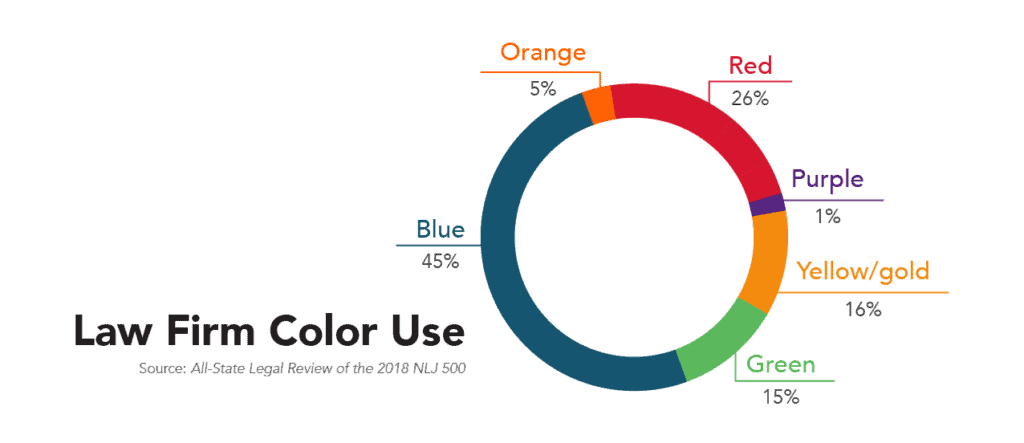
    An analysis of The National Law Journal’s list of the country’s 500 largest law firms confirmed that blue continues to reign supreme in law firm color palettes.
    Indeed, nearly half of law firms, 45 percent, use some shade of blue in their marks. With good reason: Management Decision reports that consumers make enduring decisions within 90 seconds of their initial interactions with a good or service, and “about 62 to 90 percent of the assessment is based on colors alone.” In almost any study of color theory, blue is linked to security, trust and strength.

    Because red brings such a dramatic feel, almost aggression, it must be deployed strategically. Reds should only be used by law firms that are committed to a brand identity based on swagger and confidence.

    Rounding out the primary colors is yellow. Interestingly, yellow on its own accounts for only 1 percent of law firm logos, but when combined with more gold tones, that jumps to 16 percent; law firms favor the prestige or quality connotations with gold over bright, vibrant yellows.

    Law firms that want to stand out could look beyond the primary colors to green, orange or purple, but this must be done prudently. It’s critical that your logo hues be chosen with your complete brand identity in mind. Colors should be selected to reinforce your firm’s identity, and as in all things branding, they must be relevant and authentic. Do not pick a color simply because others aren’t using it – pick a color that is unmistakably “you.”

    Custom-Built, Crowdsourced or Canva?

    Just as legal tech has changed the business of law, a number of marketing platforms have disrupted traditional graphic design offerings. While there are many ways that marketing tech can make it easier to incorporate design into your work, logo development is not the most prudent.

    99 Designs, for example, is a website where you can launch a logo design contest. Freelancers submit ideas, you pick a winner, they get paid. How do you know your logo doesn’t infringe on anyone else’s copyright or trademark? You don’t. The company states it clearly on its website: “As a contest holder, the onus is on you to take reasonable steps to check that the winning design in your contest is original and won’t land you in hot water.”

    Yes, the onus is on you.

    Similarly, Canva makes millions of design elements available – some for free, some with a $9.99 monthly fee. The website says you can “Customize your logos with our library of vectors, graphics, icons and illustrations,” and it’s important to read that carefully: Your logo, our library. Canva maintains all intellectual property rights to these images, so it effectively owns your logo.
    It is one thing to use a Canva to make a slick presentation or to create a social media graphic. It is entirely another to cede all ownership of your mark to an online database used by 30 million people. With a Canva logo, there’s nothing to stop another law firm from using your mark; moreover, there’s nothing to stop a shady used-car dealer or the next Ashley Madison from using your mark. Without ownership of your logo, you have zero recourse for infringement.

    Safeguard your logo with smart contract language. Get it in writing that your logo design is work for hire, and that all intellectual property rights are transferred to you upon payment. Eliminate any ambiguity as to who owns your mark.

    The importance of your name, your logo and your brand make this consideration trump all others. Your logo can be descriptive or nondescriptive, symmetrical or asymmetrical, royal blue or chartreuse. Just make sure it’s yours.

  • Lawyers are Skeptical. Does Your Marketing Help or Hurt?

    A recent study uncovered a number of ways marketing can increase skepticism, and this should be of particular interest to those of us in the legal industry.

    Skepticism, of course, is a hallmark of the lawyer personality: After analyzing hundreds of lawyers, psychologist Larry Richard reported that skepticism is the dominant personality trait of the profession. Lawyers average around the 90th percentile for skepticism; the general public is at the 50th percentile.

    While high skepticism is critical to many areas of practice (due diligence, depositions and more), Richard reports that lawyers may not shift out of this gear in other facets of life: “…the skeptical litigator may be well suited for adversarial encounters, but this same litigator will maintain the skeptical stance in partnership meetings, while mentoring younger lawyers, or in heading up a committee, despite the fact that these situations may all be performed more effectively in a climate of trust, acceptance and collaboration.”

    In the context of marketing, this skepticism can affect any number of scenarios:

    • A general counsel’s evaluation of an RFP or law firm pitch.
    • A litigator’s search for local counsel.
    • A lawyer’s validation of a referral.
    • A law firm’s evaluation of a legal tech solution.

    The list goes on.

    If you do business with lawyers in any capacity, it’s imperative to acknowledge their inherent skepticism and build smart legal marketing that counters it. And the findings of new University of Oregon research can help us do just that.

    The study aimed to look at what happened when a person recognized they were being persuaded – namely, how that realization affected their evaluation of and willingness to buy a product or service. It explored a number of tactics:

    Persuasive Speech

    Participants were shown a visual with a character describing “a soap that smells good and is gentle on your hands.” A second visual added the text, “You HAVE to buy it.”

    After the addition of that sentence, skepticism increased, lowering both the favorability ratings of the product and purchase intentions.

    Spokesperson

    In another experiment, test subjects were shown the same ad text with three different visual presentations. One had no visuals; one had an outline of a girl on a bicycle; one had an added “quote bubble” with persuasive words being spoken by the girl.

    When the participants recognized they were being “sold,” even by a two-dimensional illustration, their defenses went up: They reported lower purchase intentions and willingness to pay for the product.

    Price Detail

    In a third experiment, 200 adults were shown an ad for a “limited time offer” to get seven packets of seed butter for free…except for a shipping cost of $10.99. Half of the participants saw the full price information on one page; the other half saw the shipping cost details on a second page.

    Those who saw the full explanation had little skepticism. But the “low transparency” group that had to refer to a second page became more skeptical, with lower affinity, purchase intentions and willingness to pay.

    What This Means for You

    Whether it’s soap or seed butter or securities law, no one likes to feel sold. Instinctively, our guard goes up when we feel we’re being strongarmed; given their inherent skepticism, lawyers generally may have a lower tolerance and a stronger defensive response. (According to Richard, the second-most prevalent personality trait in lawyers is autonomy, which can amplify this effect: As he writes, “it’s common for lawyers to resist being managed, to bridle at being told what to do, and to prize their independence.” In other words, don’t tell me what kind of soap to buy.)

    Consider these lessons both in your one-to-many communications (e.g., your website) and in your one-to-one communications (e.g., your referrals, your proposals, your presentations).

    Persuasive Speech: Make your case with evidence, not editorializing. In pitches, lead with a declarative statement, such as “Wayne & Kent is the ideal solution for this litigation for three primary reasons,” then make your case with facts: number of similar cases handled, key accomplishments, familiarity with venue/judge, et cetera.

    On your website, present the four types of legal marketing evidence. Design your calls to action to empower the reader, not boss them around: “Learn more” is less likely to trigger skepticism than “Engage us today.”

    Spokesperson: While you may not have cheesy TV commercials with a celebrity endorser, you have a number of active spokespeople: your referral sources. Help your referral sources share, not sell: “Elle Woods has handled many cases just like this one, check out her bio” is far less likely to trip skepticism wires than “Elle Woods is amazing, and you simply must use her!”

    Consider this when it comes to testimonials, too, if you use them: Encourage clients to share their stories and sentiments, but avoid anything that borders on urging. Tip: If it contains the word “you,” cut it out. (You must use them, you cannot find any better law firm, et cetera.)

    Price Detail: Do not make your prospective client work too hard to figure out the actual bottom-line numbers. The allure of a deal will morph into skepticism if the price is obfuscated or overly complex. If you are presenting hourly rates, provide a reasonable estimate for how long the project will take. If you are presenting an alternative fee arrangement that includes a success fee or bonus, show the maximum cost the client could incur, and spell out the components or conditions.

    Again, no one likes to be sold. But lawyer or not, humans respond to individuals and organizations that respect our intelligence; show empathy to our situation; and empower us to make informed choices with examples and evidence.

  • Can Your Brand Be Too Premium?

    It is almost an enviable problem.

    After a law firm – let’s call it Stark & Banner – won a number of high-profile, high-stakes cases, the firm earned a reputation as a premium litigation boutique in its area of specialty.

    The challenge: The market has started to perceive Stark & Banner as only handling the biggest, baddest matters…and referrals for basic work have slowed. The lawyers are hearing comments like “Well, it’s not quite a Stark & Banner case, so who would you send this client to?”

    This stings for a number of reasons:

    • The high-profile cases in their realm are sporadic; focusing exclusively there is not a reliable source of revenue.
    • Stark & Banner can quite profitably handle more commonplace matters.
    • The firm recently hired a couple of younger lawyers to handle exactly this type of work. In addition to wanting to keep them busy, Stark & Banner counts on straightforward matters to provide experience and grit.

    How can the firm re-capture its referrals for basic work without losing its big-case cachet?

    To be sure, referrals from the lawyer community are critical for Stark & Banner, just as they are industrywide. According to Clio research, 59 percent of consumer clients seek a referral of some kind when they need a lawyer. On the corporate side, they are even more significant; Greentarget that both the C-suite and in-house counsel rely on “recommendations from trusted sources” most when scouting potential law firms.

    Stark & Banner needs to reiterate to the market that it is ready, willing and able to handle bread-and-butter cases in its area of expertise – but the firm is understandably hesitant to launch a campaign that dilutes its standing as the firm of choice for complex matters. (And we’re not that keen on “Stark & Banner: Here for your run-of-the-mill-stuff, too.”)

    When a marketing problem is this nuanced and complex, it helps to fall back on the fundamentals. Specifically, let’s look at the “Four Ps” of the marketing mix: product, price, place and promotion.

    Product. Since the firm is targeting basic cases, there is a considerable opportunity to analyze this work and create a rich bank of knowledge; basic cases are more likely to be frequent and similar.

    Stark & Banner can consult its various sources of data (intake, billing and timekeeping systems, among others) to learn:

    • Who is doing the work? How do the tasks break out between paralegals, junior attorneys and senior partners? What kind of capacity is necessary?
    • Where is the work coming from? Who are the specific referral sources that matter most?
    • How much does this work cost? How much does it cost to complete this type of matter – not in billing rates, but in actual cost to the firm?
    • What are the meaningful subtypes of this work? For example, does one jurisdiction take substantially more time and effort? Are we promoting one homogenous case “product,” or are there a number of them?
    • How long do these cases take? This doesn’t refer to attorney hours; think weeks, months, years. How long do matters last from matter opening to resolution? At what points are there bottlenecks or significant lags?

    In addition to the quantitative information, the lawyers should think qualitatively too:

    • Why does this work matter? While every case is different, within this given area of focus, what are the common themes, stakes and client fears?
    • What happens next? After resolving these cases, are there complementary services required or common next steps? Does it make sense to bundle this work with anything else?
    • What are common misperceptions or client issues?
    • How could this be improved?
    • How are we better at this work than our competitors?

    By answering these questions (to start), the lawyers at Stark & Banner will be empowered to make informed decisions about pricing and staffing, and they may be inspired to make process improvements that help internally and externally.

    Price. Now that Stark & Banner has real data about the casework it wants to capture, it can consider new pricing options. The firm need not discount its basic work per se – but with data, it could calculate options for fixed fees. Again, the matters in question are frequent, similar and reasonably straightforward; they lend themselves to fixed fees. This alleviates a common client concern: According to Clio, 66 percent want an estimate of the total cost for their case.

    Place. The firm should review its online presence to ensure that, big headline cases notwithstanding, it presents as an approachable option for people who need their basic services. It is a near certainty that a potential client will look at the firm’s website or search for “Stark & Banner” after receiving a recommendation.

    Indeed, according to Clio data, while 59 percent of consumer clients seek referrals, 57 percent search on their own – and 16 percent did both.

    What they are looking for:

    • 77 percent want to know the lawyer’s experience and credentials;
    • 72 percent want to know what kind of cases they handle;
    • 70 percent want a clear understanding of the legal process and what to expect.

    Of course, the Stark & Banner website should trumpet its major accomplishments – but it should also show examples of the everyday work. The list of practice areas or services should present a menu of options that is easy for a non-lawyer to understand; website visitors can self-select the content most relevant to them, whether it’s for basic services or high-stakes matters.

    Finally, the Stark & Banner lawyers can position themselves for more of the straightforward matters by providing educational resources for prospective clients (What to Expect, Frequently Asked Questions, What to Bring/How to Prepare, and the like).

    At the same time, the firm should Google itself – are all of the first-page hits centered around the cases that are more the exception than the rule? Are the firm’s social media pages welcoming to the general public?

    Promotion. We do not want to cannibalize the opportunities for high-stakes work; it’s critical to preserve the firm’s reputation in that arena. We would draw upon the work done for the Product and Price components to develop messaging that separates the basic work into something new – a subtle professional services version of a “flanker strategy,” like the Mercedes C-Class or Courtyard by Marriott.

    Options to consider:

    • The new hires: Introducing them as the go-to contacts is a “news hook” that also preserves the Stark & Banner partners for major matters. The new attorneys can be introduced in coffee meetings, bar association publications, website press releases, firm social media and more, and positioned as the firm’s resources for this work.
      “Jane, I wanted to introduce you to John Doe, who joined our firm to handle X…please keep us in mind if you have clients or contacts who need help there.”
    • The new product: Did the research into the product lend itself to any revelations or process improvements? That’s a news hook, too.
      “Jane, we wanted to tell you about our firm’s new approach to X cases…”
    • The new price: If the firm did adopt a fixed fee or another new pricing strategy, that’s a great message for recurring referral sources and the website.
      “Jane, a lot of our clients have been asking for predictable pricing for X, so we have put together some options. Please check it out, and let us know if we can ever help your clients or contacts.”

    In walking through the four Ps, Stark & Banner now has:

    • A firm handle on exactly what it’s selling – and ideas on how to do it better;
    • A price that’s more competitive – but not necessarily discounted;
    • A website that validates referrals and more effectively captures business from them; and
    • Messaging that encourages more of the basic referrals while maintaining the firm’s prestige.

    The fundamentals are, well, fundamental for a reason: They keep the firm from chasing one-off tactics or trends, and they generate a marketing strategy that is thoughtful, well-rounded and authentic.

  • What Small Businesses Want and Need From Lawyers

    Much of the legal industry buzz is devoted to large corporate clients with robust legal departments – but this disproportionate share of voice does not reflect the state of American business, nor the state of many law firms’ client base.

    Indeed, the average revenue for a Corporate Legal Operations Consortium member is $18.8 billion. (Billion, with a B.) The average CLOC company has a legal department headcount of 104; 95 percent of small businesses have no internal legal resources whatsoever.

    But nationwide, the 30.2 million small businesses employ 47.5 percent of the country’s workforce and comprise 44 percent of economic activity. The small business sector brings considerable opportunity for savvy law firms – but it’s essential for lawyers to understand how the wants, needs and pressures of these companies differ from those of the corporate behemoths.

    While the particulars may vary, a study by Kingston University, The Legal Needs of Small Business, provides critical insight. Researchers surveyed more than 10,000 individuals in organizations employing 50 or fewer people. Their industries ranged from agriculture to wholesale/retail; they covered a span of years in business, a mix of B-to-B and B-to-C, and both profitable and pre-profit enterprises.

    KEY FINDINGS

    Number of Legal Problems. The average company reported 10 legal problems per year, or a little less than one per month.

    Type of Legal Problems. More than half of these problems stemmed from commercial/contract issues or taxes:

    • Commercial/Contract – 37.5 percent
    • Tax – 22 percent
    • Employment – 14.5 percent
    • Intellectual Property – 8.8 percent
    • Real Estate – 7.1 percent
    • Regulation – 4.5 percent
    • Corporate Structure – 2.8 percent
    • Finance/Debt – 1.1 percent
    • Other – 1.8 percent

    Turning Points for Types of Legal Problems. In one bit of fascinating data, the researchers identified the “turning points” for different types of legal problems – the size at which an organization became likely to face a certain kind of issue:

    • Intellectual Property – 46 employees
    • Corporate Structure – 34 employees
    • Regulation – 31 employees
    • Employment – 29 employees
    • Commercial/Contract – 27 employees
    • Tax – 26 employees
    • Finance/Debt – 25 employees
    • Real Estate – 24 employees

    The Effect of the Legal Problem on the Business. Legal issues can have major impact on a small business. Among the results:

    • Loss of income – 25.6 percent
    • Loss of customer or contract – 9.2 percent
    • Additional costs – 8.8 percent
    • Inability to complete scheduled work – 8.7 percent
    • Damage to reputation – 8 percent
    • Damage to relationship with another business – 7.4 percent
    • Inability to take on new work – 5.2 percent
    • Damage to property – 1.9 percent
    • Change in ownership/structure of the business – 1.9 percent
    • Loss of employees (other than through dismissal) – 1.8 percent
    • Cease in trading – 1.8 percent

    The Effect of the Legal Problem on People. Small business is inherently personal; legal issues hit harder when they threaten your livelihood or your family’s legacy. Sixteen percent of respondents said that in the wake of a legal problem, they felt stress-related illness; five percent said they felt ill physically; four percent had a mental health issue; and 20 percent felt any combination of these.

    Problem Solving. When asked how they tried to handle their most recent problem, more than half – 52 percent – said they worked entirely on their own. It’s worth noting that 23.4 percent used an independent advisor … but 16.8 percent turned to friends or family members, despite rating their friends and family’s legal and professional knowledge only “adequate” or worse. Nine percent of those who turned to friends and family admitted they had “no knowledge at all.”

    Meanwhile, 21.5 percent used the Internet to find contact details; 21.3 percent used the Internet to find advice; and 15.1 percent used the Internet to research their legal position.

    Choice of Legal Provider. The most common reasons for choosing a legal services provider:

    • Reputation – 30.1 percent
    • Specialty – 24.5 percent
    • Previous use – 24.4 percent
    • Cost – 15.7 percent
    • Referred by friends or family – 9.9 percent
    • Convenience – 9.8 percent
    • Friends or family believed to have relevant expertise – 9.4 percent
    • Accountant referral – 8.6 percent
    • Trade organization referral – 8.4 percent
    • Speed of delivery – 7.6 percent

    Attitudes on Lawyer Fees. When asked their reaction to the statement “Lawyers provide a cost-effective means to resolve legal issues,” only 13.4 percent agreed. Nearly half, 47.1 percent, disagreed, with 15.3 percent disagreeing strongly.

    Attitudes on Lawyers as a “Last Resort.” When asked their reaction to the statement “I only use a legal services provider to solve business problems as a last resort,” 49.9 percent agreed; only 14.1 percent disagreed, with 6 percent disagreeing strongly.

    WHAT THIS MEANS FOR LAWYERS

    Keep in mind that nearly half of small business owners view lawyers as a last resort – and that despite legal problems making them physically ill, they are almost as likely to ask friends and family members to solve an issue than they are to engage an independent resource.

    The traditional way of doing business is not working for these entrepreneurs. It’s time to reimagine the model, and adjust our legal marketing along with it. The “Four Ps” of marketing are a good start:

    • Product: Instead of intimidating hourly rates that discourage proactive calls or preventive medicine, consider packages that address common small business needs at a predictable price. (Or consider giving this pro bono; Spencer Fane’s STARTUP Lab is a powerful example.) Such arrangements can be loss leaders, as these clients will have more positive associations with the firm, develop relationships there, and be more likely to stay as they grow.
    • Price: Beyond discounts, how can you make your services more palatable for a startup or small business? Flat fees can provide the budget predictability and calm billable-hour trepidation, and business contingency litigation can even the playing field in a David-vs.-Goliath dispute.
    • Place: Recall that business owners go online to find legal advice, research their options and scout contact details. Make sure you are networking effectively online: Position yourself to be one of the resources they find while Googling.
    • Promotion: The top two selection criteria for lawyers are reputation and specialty, far exceeding factors like cost and convenience. Note that it’s “specialty,” not “general mediocrity at everything”; whether you are working in a full-service firm or marketing a niche law firm, lean hard into what you do better than anyone. Make sure your attorney bio conveys your specific expertise, and use the four types of marketing evidence on your website to show you are a safe choice.

    The authors of the Kingston University study repeatedly stress the need for greater communication between the legal industry and small business, and we wholeheartedly agree. For this messaging to be effective – and for lawyers to overcome their current position as “unknown and distant” – this messaging must be targeted, authentic and relevant to entrepreneurs.

    One-size-fits-all marketing so often results in ill-fitting extra-extra-large branding; this will not appeal to your prospects who need an extra-small.