Category: Industry Insights

  • Present, Past and Future: A simple model for your personal and firm brands

    Present, Past and Future: A simple model for your personal and firm brands

    While working to solve the stress of the oft-dreaded “elevator speech,” the helpful folks at Harvard Business Review have presented a new model that, applied broadly, can provide an effective and consistent framework for law firm branding – from lawyers to practice groups to the firm at large.

    The HBR approach takes three steps to craft a better personal introduction:

    1. Present: Start by introducing yourself in your present situation.

      • I am Jane, and I am a litigation partner at Clark & Kent.

    2. Past: Next, add two to three points about your previous experience that establish credibility.

      • I have practiced in employment litigation for twenty years. I have successfully resolved disputes regarding discrimination, harassment and retaliation for clients in a number of industries. I recently achieved three consecutive defense verdicts in federal court.

    3. Future: End by speaking to what’s next for you (as relevant to the audience).

      • In addition to helping clients resolve disputes, I enjoy working with organizations on proactive policies and training, so they can reduce litigation – or eliminate it altogether.

    As HBR notes, this approach is “eloquent and effective” – and it reduces the risk of rambling or forgetting something important.

    It’s simple to see how this formula could be deployed for lawyer biographies. But beyond those core components of legal marketing, it can easily expand to other law firm marketing communications. It solves the “blank page problem,” where writer’s block creeps in even on subjects we’re familiar with – our own biographies, our own practice areas – because we don’t know where to start. It ensures we share the results and experience that comprise our expertise (the No. 1 reason clients choose and refer lawyers). And it prompts us to look toward the future to talk about what we want to do and how we want to help.

    Let’s experiment with a practice group description using the “Present, Past, Future” approach.

    Present

    The patent prosecution team at Stark & Banner helps clients in high-tech industries protect their most important innovations.

    Past

    We have worked alongside engineers and product developers to secure thousands of patents over the past 10 years. Our team, which includes former patent examiners at the U.S. Patent and Trademark Office, has earned a top-10 quality rating from Patent Bots each year for the past five years.

    Future

    We welcome the opportunity to take on your biggest IP challenges, from the most complex technology to the most competitive markets.

    While this example is purely hypothetical, it nonetheless shows how to apply the Present, Past and Future to talk about your law firm. Applied firmwide, it could bring the benefit of consistency across practice pages – no more two-sentence brief for Appellate, with a magnum opus for Zoning.

    For the next bio or practice group summary or actual “elevator speech,” channel your inner Marty McFly: start with the Present, roll back to the Past, end with the Future.

    Where we’re going, we may not need roads, but a consistent framework is always helpful.

  • Your Law Firm Website: Give the Laterals What They Want

    Your Law Firm Website: Give the Laterals What They Want

    Talent remains the No. 1 challenge for law firm leaders, according to a June report from Thomson Reuters.

    The current talent fracas notwithstanding, the fight for quality laterals has always been a heated one. Throughout the last decade, about 2,750 laterals moved about the AmLaw 200 each year, with an average book of business of $2 million.

    Indeed, according to analysis by Decipher and ALM Intelligence, lateral partner hires are the “single largest source of revenue growth potential for law firms.”

    We know that lateral partners shop around; according to Major, Lindsey & Africa’s 2020 Lateral Partner Satisfaction Survey, 70 percent of laterals considered more than one firm. More than one-third, 35 percent, looked at four or more firms.

    How can your website set your firm apart as an employer of choice?

    Content

    Your site should address the factors lateral candidates say matter most. In the Major, Lindsey & Africa report, the top three priorities were:

    • Practice area support
    • Firm culture
    • Personality of partners

    These concerns outranked anticipated compensation, client base and geographic reach, among others.

    Keep your laterals in mind with smart tactical presentation:

    Practice area support. Do your practice area pages show investment in the subject matter, in terms of bench strength and thought leadership? Do they demonstrate that you are present at the organizations that matter? Beyond a roster of the lawyers, do they provide information on key administrative personnel that help clients and timekeepers?

    Most of all, do your practice area pages convey that your firm is a safe and smart place to trust a lateral’s hard-earned book of business?

    Firm culture. What is it like to work at your firm? Is it formal, casual, traditional, organized or laissez-faire? This is a subject where “Show, Don’t Tell” matters: Don’t just say you have a great culture, show examples that help potential laterals see themselves working with you.

    Share firm traditions – whether elegant or offbeat. Bartimus Frickleton Roberton Rader’s website highlights the firm’s standing “Sandwich Tuesday,” where the team meets to make hundreds of sandwiches for a local shelter. A website visitor can see the managing partner and one of the named partners in the kitchen, with gloves on their hands, assembling sandwiches. The message: We give back to the community – but we expect you to roll up your sleeves, too.

    Personality of partners. Simply put, are you jerks? Are the partners at your firm the kind of human beings one wants to spend their days with?

    It’s helpful to incorporate some humanity into lawyer bios; this can be done through warm photography, a captivating narrative, and more. But to truly let your partners’ personalities come through, nothing tops video. Nexsen Pruet’s website has a dedicated video center, where partners discuss legal news of note. After the lockdown phase of the pandemic, Nexsen Pruet posted a reassuring message from its managing partner, which explained return-to-office protocols along with video that showed them in action.

    It’s worth noting that the personality of your partnership is of heightened importance to two critical audiences for diverse recruiting. Both women and Black lawyers rated “personality of partners” higher than the total response base.

    Format

    As you build or update your site, make sure your “Careers” page is not only speaking to law students. Your laterals are a vastly different audience; they merit a specific section that addresses their wants and needs.

    You do not need truckloads of content, but acknowledge that lateral lawyers are at a different life stage than your summer clerks. Mayer Brown uses an elegant structure on its Careers page, with breakouts for Experienced Lawyers, Graduates & Law Students, and Business Services.

    Candor

    Be honest about your firm – about who you are and what you offer. While the website cannot make any warranties about compensation, nor deliver upon them, the website does set the tone for those intangibles that laterals prioritized: practice area support, firm culture, partner personalities. Not every law firm is modern or casual – and not every lateral wants that.

    In the Major, Lindsey & Africa lateral survey, fewer than half of respondents rated their current firms as “very candid” in the recruitment process. Nearly 20 percent said their firms were “not candid.” This was especially true for diverse audiences: Hispanic lawyers were more than twice as likely as white lawyers to describe their firms as “not very candid,” while women were 20 percent less likely than men to say their firm was “very candid.”

    Your website may be among the first “touches” your law firm has with a prospective lateral. Start the recruiting process with a purposeful approach that introduces your firm, shows your strengths, and accurately presents the working environment. Help these laterals determine the fit from the start – and always remember you can present the firm in its best light without resorting to a dishonest disconnect.

  • Should your legal brand be tough or tender?

    Should your legal brand be tough or tender?

    Law firm branding can present a paradox: There’s a contradictory conventional wisdom that clients want relentless gladiators in the courtroom or boardroom….who also happen to be extraordinarily nice, responsive and service-oriented outside of it.

    It’s a tall order, and the effort to do both results in weak law firm brands. Firms that try to be everything end up standing for nothing; firms that try to switch gears from aggressive to cuddly suffer from split personality syndrome.

    As you consider the identity you – as a human or a firm – present to the marketplace, it’s helpful to understand what we as human beings are programmed to favor, as well as the emotions most often at play in legal matters.

    Or, to make it simple: Should you smile or smolder in that bio photo?

    Two Universal Brand Drivers

    While there are myriad facets of brand identity, it turns out there are two that account for 82 percent of client sentiment.

    These elements – warmth and competence – were confirmed over 10 separate studies by Chris Malone and Susan Fiske, and reported in The Human Brand. These two characteristics govern our judgments of the world around us, including individuals, groups of people, teams, companies, nations, brands….and yes, law firm brands.

    What’s behind them:

    • Warmth: We quickly evaluate whether an entity is kind, friendly and good-natured; whether it appears sincere, honest, moral and trustworthy; and whether it is perceived as helpful, tolerant, fair, generous and understanding.
    • Competence: As the authors describe it, “How successful would they be in carrying out their intentions toward us? … Do they appear efficient, capable, skillful, clever and knowledgeable? Do they possess the confidence and ability to carry out their plans?”

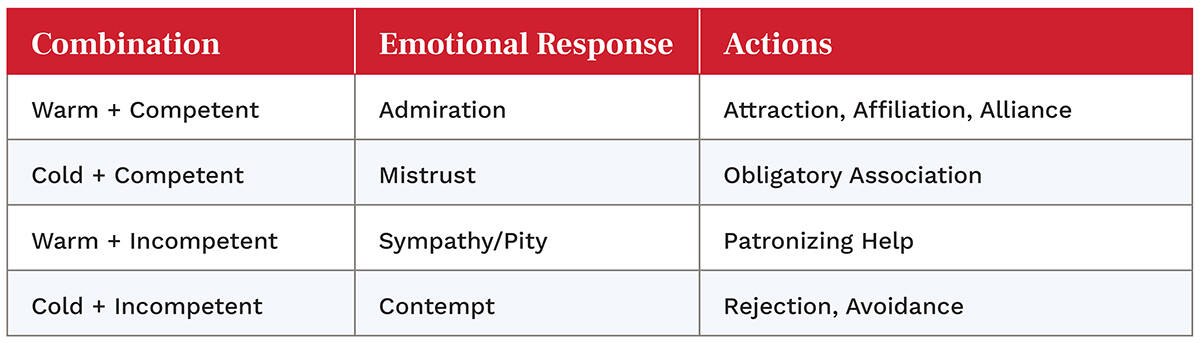
    The interplay between the two is significant:

    In the pursuit of brand loyalty, Warm + Competent is the clear winner, sparking attraction and affiliation. Law firms should note with caution the combination of Cold + Competent, which results in “obligatory association” – and client flight risks.

    Moreover, law firms that are viewed as both warm and competent may have a bit of an insurance policy against the occasional mistake (or loss in litigation). As Malone and Fiske note, “When companies held in high esteem for warmth and competence make errors and stumble, they are able to recover from those errors, building even more genuine, trusting and lasting relationships with customers.”

    While warmth and competence are said to be universal – governing our thoughts on everything from pets to basketball teams – it’s helpful to check their applicability in the specific legal context.

    Harvard Law School’s The Practice shared research into the brand drivers specific to law firms – the qualities that lead clients to select, stick with and recommend their lawyers. The top three:

    • Expertise: “The quality, specialist knowledge, star individuals, breadth of services, or results achieved.”
    • Service: “Responding quickly, being available and accessible, and generally giving high levels of client service.”
    • Relationship: “A true partnership that is highly valued by both sides.”

    Expertise, service and relationship – in other words, competence and warmth – bested all other themes, including business savvy, geography, style, value and reputation.

    Advocating with Empathy: Understanding Client Emotions

    It’s helpful to acknowledge exactly how and why warmth matters in the legal setting – particularly when considering the perception that many clients want “bulldogs,” not BFFs.

    Too often, attorneys do not understand their clients’ emotional state, according to a Clio survey of both lawyers and clients.

    The survey asked clients to list their feelings about their legal problems, then asked lawyers to guess which feelings came into play. Interestingly, lawyers accurately predicted that clients can feel anxiety, control, annoyance and anger. However, lawyers missed five others.

    Lawyers underestimated four key feelings:

    • Relief: While 51 percent – more than half – of clients feel relief to address and resolve a problem, only 17 percent of lawyers named this as a potential emotion.
    • Frustration: 40 percent of clients feel frustrated, yet only 8 percent of lawyers guessed it.
    • Urgency: 33 percent of clients want fast answers; only 15 percent of lawyers perceive that.
    • Disbelief: One-quarter of clients may feel shock or denial, yet just 11 percent of lawyers could foresee it.

    Meanwhile, lawyers vastly overestimated their clients’ potential for confusion: Nearly half (45 percent) of attorneys guessed that their clients were befuddled by legal proceedings, while only 27 percent actually were. (There’s an important lesson here about education without condescension: Later in the same Clio report, fewer than half of client respondents said lawyers were “pleasant to work with.”)

    Recall that warmth is evaluated in part by a sense of “understanding.” How well do you and your firm show a true comprehension of client emotions?

    Marketing with Warmth + Competence

    How can you most effectively incorporate these two critical characteristics into your law firm branding and marketing communications?

    Demonstrate competence with evidence. The authors of The Human Brand said we as humans classify others as competent or incompetent based on an assessment of the likelihood they can deliver. Show potential clients your competence – and then reassure them – with evidence:

    • Experience, including compelling case studies;
    • Happy clients, including reviews and testimonials;
    • Subject-matter prowess, such as articles and presentations; and
    • Third-party endorsements, such as awards and rankings from reputable industry organizations.

    Convey warmth with personality. Once you have demonstrated capability – truly table stakes in the legal profession – show your human side. This does not require asking every lawyer in the firm to become a fuzzy bunny. Instead, think about the broad definition of warmth as presented by Malone and Fiske: “kind, friendly and good-natured…sincere, honest, moral and trustworthy…helpful, tolerant, fair, generous and understanding.”

    For a law firm, warmth could be shown through:

    • Purposefully crafted biography narratives that are informal (“Lois v. “Ms. Lane”) and tell the story of the subject’s background, inspiration and style. One masterful example is the presentation of lawyers at Ohio’s Graydon Head & Ritchey, where every practitioner has both “My Bio” and “My Story.”
    • Inviting photography of the lawyers as well as the offices and illustrative images. (Nothing says cold and possibly incompetent like stale stock images.)
    • Presentation of community investment, including pro bono efforts and sponsorships.
    • True commitment to diversity and inclusion.
    • Personable social media accounts. Think first-person, informal photos, conversation over presentation.
    • Interactive media that allow the prospective client to “meet” the lawyers and firm leadership, including podcasts and video. It’s one thing to read someone’s bio; it’s a much more intimate experience to hear their voice and see their style.
    • An inviting reception area where people are greeted with courtesy, respect and a Wi-Fi password.

    Walk the walk. If you are marketing an identity of warmth and competence, back it up. If you are a cold workplace, the world will soon find out through Glassdoor and other avenues. If your lawyers are incompetent, no slick website can compensate for scathing Avvo reviews and malpractice suits.

  • Ten tips to improve your odds this award season

    Ten tips to improve your odds this award season

    The legal industry may have a love-hate relationship with awards and rankings, but these credentials do have a significant role in the marketing mix: According to Greentarget’s State of Digital and Content Marketing Survey, half of in-house counsel say these accolades are important factors when screening new outside firms. That increases to 56 percent for the C-Suite.

    Together, awards and rankings were viewed as more important than blogs, social media and quotes in relevant publications.

    Award season beckons: This month alone sees deadlines from the World Trademark Review 1000, Benchmark Litigation and U.S. News & World Report/Best Lawyers in America’s “Best Law Firms,” among others. Soon, the annual parade of Chambers deadlines will be among us.

    How can you play to win?

    One: Make a plan.

    Go into award season with a plan. What are the awards that are most important to you? What awards have demonstrated credibility in the marketplace? For what awards are you an ideal candidate – whether age, level of experience, geography, et cetera? (Be honest here. There’s a season in your life for 40 Under 40, and there’s a season in your life for Leading Practitioners, and they rarely intersect.)

    If you are not sure which awards to prioritize, look at some of your leading competitors and role models. What do they tout on their bios?

    Two: Be selective.

    There is a cottage industry of awards run by enterprising folk looking to capitalize on lawyer egos. Watch out for some of the frequent red flags:

    • Pay to play. Generally, the most reputable honors do not require any money to participate. (They will look to upsell you on profiles and ads and badges and cufflinks later, sure, but there is no charge to be evaluated.)
    • Be wary of any new award that comes to you directly after you’ve received another; many fly-by-night rankings simply browse the winners of other awards and try to sell a $500 plaque with a new name at the top.
    • Overall shadiness. Look for misspellings, typos and missing words. Scam rankings are often sent under a very common name, like “Michael Smith,” so you cannot find them on LinkedIn.

    While an invitation to be honored is very flattering, keep your ego in check: If you have never heard of a given award, it’s likely your clients haven’t, either.

    Three: Look at precedent.

    For your priority awards, who won last year? What common threads can you determine? If it’s an individual award, do the winners seem to have a high level of community service, leadership positions in their firms, et cetera? For team accomplishments, is there a certain size of matter considered – verdict, settlement or deal size? These can provide clues as to what the judges are looking for – and how your odds shape up.

    Four: Provide context.

    While you are intimately familiar with your clients and projects, you cannot assume the award judges are. For example, most of the research analysts at Chambers & Partners are based in London; you cannot expect them to have in-depth knowledge of the real estate market in Alabama. Educate.

    Do not submit an anemic blurb like “Advised XYZ Company on new location” and expect the judge to know what XYZ Company is or does. Fill in the details: “Advised XYZ Company, a publicly traded baker and distributor of bread and desserts, on all aspects of its sixth bakery facility, which is expected to add 200 new jobs to Smallville, Kansas. Our firm has advised XYZ Company, a long-time client, on its past four real estate deals, expanding its market across the U.S. It has grown by more than 300 percent since its IPO.”

    This need not be a heavy lift; often, the color commentary is available with a few clicks on your clients’ websites. Annual reports and press releases are invaluable sources of such information.

    Five: Make an argument.

    Keep in mind the judges will see a plethora of award entries, many of which simply extoll the virtues of the nominee. And many of which will elicit a “so what” from a judge who is pressed for time and stuck skimming through a stack of indistinguishable nominations.

    Every award entry should make a case: “Lois Lane merits inclusion in this year’s Forty Under 40 for three primary reasons: x, y and z.” “Kent & Luthor is the leading litigation boutique in the Rocky Mountains because a, b and c.”

    Start your entry with an opening statement, and back it up in the following paragraphs.

    Six: Follow the rules.

    Again, make it easy on the judges. Don’t make it a burden to evaluate the firm. Make the deadline. Meet the criteria. Use the portal. (Even if the instructions say you do not technically have to use the portal, use the portal. Who would you be more sympathetic to – the firm that enters everything in your system or the firm that requires extra work of you?)

    Seven: Never surprise your client.

    Whether you are using a client as a reference or as a work example, your request must be made clearly and well in advance. If you are asking for a reference, manage the expectations for when they will be contacted, how they will be contacted (email, phone, et cetera), and what kinds of questions they can expect. If you are using a client project as a representative matter, get permission in writing.

    Eight: Beware “reference fatigue.”

    Throughout the year, a number of rankings may ask for client references. Do not share the same people for all; this gets annoying fast. Work to determine the timelines for specific rankings, and stagger your requests so no one contact is receiving more than two queries about you each year.

    Moreover, develop a central rankings clearinghouse of sorts: If one particular client happens to have relationships with various practice areas at the firm, ensure this client is not being listed on every practice group’s nominations.

    Nine: For references, prioritize responsiveness.

    Someone who answers the phone is a better reference than a figurehead who will not. If the general counsel won’t participate but the paralegal will, use the paralegal. There is no extra credit for seniority.

    Ten: Share good news.

    Once you earn an award, announce it in good taste: Share it on social media. Add it to your biography and marketing materials. Thank your references. Send the article to your mom.

    As with all marketing, effective award competition is about empathy: Have empathy for the judges by showing that you understand the award, the parameters, the deadline and their process; make it easy for them by presenting a clear and well-evidenced case. Have empathy for your references by making reasonable, well-explained asks, and by respecting client confidentiality.

    Empathy helps when marketing your awards, too: Remember that awards and honors – like “USDA Approved” – can indicate a safe choice. Use awards as visual cues that you are a safe and reliable choice, and deliver in a way that befits the honor.

  • Seven Deadly Sins of Law Firm Websites

    Seven Deadly Sins of Law Firm Websites

    In the wake of the pandemic, law firm websites have become a more critical part of the legal buyer’s journey. Lockdowns may be over, but remote work and virtual events have changed our habits profoundly and permanently.

    Before COVID-19, 64 percent of in-house counsel said law firm websites were important in the selection process, according to Greentarget. After, Thomson Reuters reports that some law firms have seen website traffic increases of up to 40 percent in the post-COVID era.

    Your law firm website is, increasingly, your primary opportunity to make the right first impression and to convert prospects into clients.

    So it’s a shame so many firms get it wrong.

    This list is certainly not exhaustive, but it chronicles seven of the most common misdeeds perpetrated by law firm websites. This is about more than pet peeves: According to Hubspot, the average time spent on a website is just 54 seconds. It is critical to connect quickly; prospects will not stick around long enough to get to know your sparkling personality buried under a clunky interface.

    With every sin committed, you are likely to turn off a prospect – and send them to a competitor.

    Sin One: Evasive Contact Information.

    As an organization that is looking to trade legal services for legal tender, you must understand that the primary purpose of your law firm website is to connect prospective clients with the lawyers who can help them.

    Your website must make it incredibly easy for prospects to find and contact your attorneys:

    • Use guiding language, like “Meet Our Team,” “Who We Are,” or the concise “Attorneys” in primary navigation.
    • On lawyer bios, include multiple methods of contact, such as phone, email and LinkedIn.
    • Make a “Contact Us” option prominent on the top and bottom of the page. The top of the page is where people look first, while many of us have been conditioned to find phone numbers at the very bottom.
    • If you have more than a handful of lawyers, include a Search option for your team, so prospective clients can filter options by practice, office and more. Do not make them hunt and peck through 20 bios to find the guy who does Bankruptcy.

    Take a look at your site through the perspective of a prospective client who is running late for a meeting. How easy is it to find a phone number and an address with one hand, while driving and holding a cup of coffee?

    Sin Two: Mobile Mishaps.

    A quick review of the websites we manage shows that approximately 40% percent of traffic comes from mobile devices like phones and tablets.

    Meanwhile, according to the American Bar Association’s most recent Legal Technology Survey Report, the profession gets a D for mobile-friendliness, as just 68 percent of the law firms surveyed said their websites were mobile-friendly. Six percent said they were not, and sadly, 26 percent – more than 1 in 4 – had no idea.

    You cannot reasonably expect your prospects to pinch and zoom and scroll through your outdated website. In 2022, this is the equivalent of wearing a leisure suit to court.

    Sin Three: Diversity Disconnects.

    Too many law firm websites tout a “commitment to diversity,” but their actions don’t back this up.

    For example, is your website accessible to the 15 percent of the population with a disability of some sort? Chances are, it’s not: According to the 2020 Web Accessibility Report, 98 percent of U.S.-based webpages are not accessible to the disability community. There are straightforward ways to make your website inclusive (and ADA compliant); a site that can add contrast or enlarge the type size demonstrates much more of a commitment to inclusion than hollow prose on a Diversity page.

    Moreover, take a thoughtful approach to stock images and photography. (Especially if your attorney photos show a sea of white male faces.) Are you showing a representative community of sample clients? Are you showing a representative community of success stories? On the other side, take care not to present stereotypes of your “typical” clients, especially if you work in criminal defense, family law, bankruptcy or other emotionally loaded practices.

    Sin Four: A Site Built for the Firm’s Lawyers, Not the Firm’s Prospects.

    Your website is not the firm directory.

    Your website is not the firm org chart.

    Your website is built to connect with clients. This means engaging with them on their own terms. This means not designing or writing a website to feed partner egos. This means purposefully building a site with empathy and consideration for the legal buyer’s journey. What do they need to know to make a decision? What reassurance do they need?

    Many firms do well by classifying their work done on behalf of industries; corporate clients are more likely to self-identify as an Agribusiness or Manufacturer than a consumer of Torts.

    On the consumer side, seek to educate: Family law firm Astley Putnam includes a FAQ section on its website that answers real-world questions about divorce without using intimidating legal terms. For example, “How long will it take me to get divorced?” “Can I get divorced without going to court?” and “What are the first steps in the legal process?” The firm also pledges to “make divorce more accessible” and “We will use real language, not legal jargon.”

    Your prospects are far more interested in what you can do for them – and evidence that you’ve done it before –  than your firm’s history or your time on law review.

    Which takes us to…

    graphic regarding client needs on lawyer websiteSin Five: Lack of Evidence.

    Again, your potential clients want to know that you’ve handled a problem like theirs. In a recent Clio survey, 77 percent of clients said they wanted to know lawyers’ experience and credentials; 72 percent said they wanted to know what types of cases they have handled.

    While client confidentiality is paramount, an up-to-date and user-friendly Results section is a must. This should include case studies that are relatable. No citations allowed.

    Work experience is one of the four types of evidence every law firm website needs. An effective law firm website also will show happy clients, subject-matter prowess and third-party endorsements. This evidence will prove that you are a safe choice – and, ideally, worthy of a premium fee.

    Sin Six: Neglecting Search Engines.

    Do not adopt a Field of Dreams approach with your website. If you build it, they may not come.

    Your website must be built to connect with humans, to be sure – but it cannot neglect Google and Bing. Indeed, search engines now are virtually tied with the tried-and-true prospecting method of referrals. According to Clio, when clients need lawyers, 59 percent will seek a referral, 57 percent will search on their own, and 16 percent will do both.

    When analyzed by age group, referrals become less relevant: While they are highly valued by 60 percent of Boomers, that affinity drops to 46 percent for Millennials and 47 percent for Gen Z. A savvy digital presence – and prominent search results – matter significantly when courting the next generation of clients.

    Search engine optimization is a field that is constantly evolving, but your site must be intentionally constructed to appeal to the algorithms. This means addressing “under the hood” items, such as meta descriptions and image file names, as well as substantive content that a crawling robot can see as authoritative.

    A beautiful website that is undiscoverable by Google is a profound waste of time and money.

    Sin Seven: Distracting Bells and Whistles.

    Avoid popups and sounds: More often than not, these are needless distractions. Again, remember that the average visitor will spend about 54 seconds on your site; it is unlikely they will want to spend more time there if they are annoyed.

    Videos, while incredible storytelling tools, should not be set to auto-play.

    Chatbots should be deployed with caution: While they can be a fast resource for some practice areas, bear in mind that your visitors want to talk to a lawyer, not a robot. If a chatbot makes sense for your practice, invest in a service that provides a 24/7 human response – not a robot with a decision tree.

    Most, if not all, of these sins can be avoided with a purposeful and empathetic approach to the law firm website. Bear in mind that very few clients, corporate or consumer, seek out a lawyer because they are having a great day; these are human beings in stressful situations. Your website should be an experience rooted in convenience and credibility. Your website should quickly establish trust, show that you are a safe choice, and relate to them on their terms (and their devices).

  • To Zoom or Not To Zoom: When Clients Want (and Don’t Want) to Videoconference

    To Zoom or Not To Zoom: When Clients Want (and Don’t Want) to Videoconference

    From 2018 to 2021, the percentage of clients who want to work with a lawyer remotely grew considerably, from 23 percent to 79 percent.

    However, according to research published in Clio’s 2021 Legal Trends Report, clients’ appetite for a video interaction varies depending on the stage of the matter. Lawyers looking to build strong client relationships should heed these preferences and adjust their schedule tactics accordingly.

    In 2018 – those fancy-free times before COVID-19 – no more than 4 percent of clients wanted to communicate by videoconference at any stage, according to Clio. As remote work has become more commonplace, that’s changed; for many stages of a matter, more than half of consumers are open to a Zoom meeting (or Teams or Google Meet, et cetera). However, it’s important to note that at no stage is videoconference the No. 1 choice.

    First Meeting or Consultation:

    As this is a critical time to establish rapport, it’s not surprising that 76 percent of clients want an in-person meeting. Phone calls are the second choice, with 70 percent; videoconferencing appeals to 58 percent.

    Receiving Status Updates on the Matter:

    While 60 percent of clients are open to videoconferences, it’s the fifth-most popular choice, behind phone (73 percent); in-person (68 percent); email (66 percent); and a client portal (61 percent). Clio notes, “More informal and asynchronous options – the types of interactions that don’t need to happen in real time – have higher preferences among consumers…at these points in a matter, less formal options that allow clients to review information at their convenience may be a better option for many.”

    Communicating About Key Decisions:

    High-stakes discussions mirror client preferences for the first meeting, with respondents preferring in-person meetings (75 percent), then phone (71 percent), then videoconference (61 percent). Clients want immediacy and the ability to discuss options in real time; these interactive channels beat email and secure client portals handily.

    Viewing and Sharing Documents:

    Simply put, your clients do not want to review paperwork by Zoom. It was respondents’ sixth choice, trailing the in-person meeting (71 percent) and a cadre of tech solutions: email (63 percent), secure client portal (60 percent), online file sharing service (56 percent) and secure mobile app (52 percent).

    Consider the patterns here. The effects of a global pandemic notwithstanding, not much has fundamentally changed: For big decisions, such as choosing who to hire or weighing actions in a legal matter, people want human connection. For passive interaction, such as receiving a status update or reviewing a document, people want some flexibility and autonomy.

    What does this mean for your client development?

    Know the prospect.

    Some demographics are more open to videoconference than others. In terms of age groups, Clio reports that Gen X has the highest preference for working remotely, at 72 percent; Millennials are next, with 69 percent. Baby Boomers are the most reticent to go remote, at 59 percent.

    There also is a marked difference when it comes to legal sophistication: Individuals who had hired a lawyer before were 18 percent more likely to be comfortable with videoconference meetings.

    Meet people where they are, and offer choices when you are able.

    Acknowledge the limitations.

    As we all know very well by now, videoconferencing is far from a perfect medium. There are challenges to building meaningful connections through a screen.

    For one, participants may be distracted. In a 2021 survey by Researchscape International, 39 percent of U.S. respondents said they were often distracted on videoconferences. Specifically:

    • 30 percent said they have read the news or cruised social media during a Zoom;
    • 28 percent have gone to the bathroom;
    • 25 percent said they often multitask.

    In addition to not getting your clients’ full attention, know they may feel disconnected from you as well. In the same survey, 26 percent of U.S. respondents said they feared people misinterpreted their facial expressions or body language, and 22 percent said they did not feel understood or “heard” on videoconference.

    Advocate for your clients’ best interests on Zoom. A simple branded background will help them focus on you, not on your surroundings. (This is especially important if you are working from home, and there are four-legged creatures running about.) Ask clarifying questions. Do not rush. Repeat your clients’ statements back to ensure full comprehension.

    Remember the fundamentals.

    Remote options are growing in importance, to be sure; in the Clio report, 79 percent of clients say Zoom availability has a “very positive” or “somewhat positive” influence on their selection of a lawyer.

    However, your prospects rank many other factors as more important, among them:

    • Responsiveness – 86 percent;
    • Price transparency – 85 percent;
    • Positive online reviews – 82 percent;
    • Personal recommendations – 81 percent; and
    • Online presence – 80 percent.

    People want to hear back from you; they want to know what to expect; and they want assurance that you are a safe choice – either from trusted friends or strangers on the Internet. And then they want the option to Zoom with you.

    As always, successful legal marketing comes down to empathy: Deploy videoconferencing after you have established a face-to-face relationship. Offer it as a choice. Be fully present, and help your clients be fully present as well.

    (And please do not be among the 28 percent of people who go to the bathroom during a videoconference.)