
Category: Industry Insights

  • How Small Businesses Hire Lawyers, Part 3: Retaining Small Business Clients

    How Small Businesses Hire Lawyers, Part 3: Retaining Small Business Clients

    Every year, more than 420 million legal matters can be generated by the country’s small businesses – yet most legal marketing tends to neglect this demographic in favor of corporate behemoths or individual consumers.

    There’s considerable opportunity for the lawyers and law firms that purposefully pursue startups, entrepreneurs, family businesses and other closely held enterprises. Firesign surveyed 100 small business owners and leaders to learn how they engage lawyers. In the first part of our series, we looked at how they interacted with lawyers and law firms before a specific need arose; in the second installment, we discussed their behavior when confronted with a specific legal challenge.

    To conclude the series, let’s look at retention: How do small businesses work with their law firms after that first matter?

    Sporadic Needs

    First, it’s key to acknowledge the nature of their legal matters. In a survey of more than 10,000 small businesses by Kingston University, there was an average of 13 legal matters each year, but the distribution was far from uniform. Most respondents (84 percent) reported fewer than 10 problems; the average is raised by a minority, 1.5 percent, which experienced 100 or more.

    If we look instead at probability in a given year:

    • 19 percent will experience contract/commercial issue(s);
    • 6.5 percent: employment;
    • 6 percent: tax;
    • 5.4 percent: regulatory;
    • 2.9 percent: IP.

    Unless your small business client is among the 1 percent with a whole lot of problems, remember that their primary objective is to run the business. They don’t have the time or interest to engage in legal trendspotting.

    Takeaway

    Be there when they need you. Your small business clients are unlikely to subscribe to your weekly update on trademarks or attend webinars about changes in environmental policy; most don’t face legal issues enough to make it worth their time.

    This was illustrated in the Firesign survey: When asked what actions they took after a matter was underway, 23 percent followed their lawyer on social media….but that’s fewer than the 36 percent who did nothing outside of communication directly tied to the project. Lawyers can stay top of mind by sending highly relevant legal news and engaging with sincerity on social media.

    Reluctant Legal Clients

    Second, lawyers should understand how small business owners and leaders feel about the act of hiring an attorney. The Kingston University study showed that most will try to solve the problem on their own; 49.9 percent said they would use a legal services provider “as a last resort.”

    This is a demographic that, by nature, is scrappy and self-reliant; it makes sense that they would work to solve their own problems first.

    Takeaway

    Recognize their desire for self-reliance and control. Small business owners are used to wearing all of the hats for their companies – including, sometimes, would-be lawyer. Help them feel in control with direct communication, transparency, and pricing models like flat fees, which eliminate the uncertainty of the billable hour.

    Taking It Personally

    Third, it’s essential to remember that for these clients, business is often deeply personal; they may have their personal fortunes or family legacies tied to the company. They seek human beings they can trust to take their matters as seriously as they do.

    Indeed, in the Firesign survey, the adage that “clients hire lawyers, not law firms” definitely rang true, as survey respondents were twice as likely to connect with a lawyer on social media than a law firm. (An argument for lawyers having well-developed social media profiles and posting with consistency.)

    Savvy lawyers will connect this to another piece of data reported previously – small business operators’ heavy reliance on recommendations from friends and colleagues. Taking the time to build personal relationships with small business clients (and deliver outstanding results for them) can result in referrals to their networks later – and thus, exponential dividends.

    Takeaway

    Keep it human. The most effective (and referred) small business advisers will focus on the humans running the companies – and not be afraid to show their own humanity, too.

    Personal touches go a long way. Instead of blast-emailing a legal news update from the firm, forward it from your personal account with a brief intro: “Jane, this new regulation will affect your company starting next year. I wanted you to know what’s coming.” Speak as a person: “i,” “you,” “we.”

    Does your 2024 business plan include work from the small business sector? Learn how to successfully market in Firesign’s report, From Referrals to Recon: How Small Businesses Hire Lawyers.

  • Another Argument for Lawyer Rankings: Search Results and the AI Meritocracy

    Another Argument for Lawyer Rankings: Search Results and the AI Meritocracy

    Love them or hate them, we know that lawyer rankings are used by your human prospects to scout legal talent; according to Greentarget, 62 percent of C-suite members and 52 percent of in-house counsel report them as “important” when researching new firms.

    But there’s a new audience that must be factored into our marketing strategies: Generative AI.

    Since ChatGPT’s public launch in November 2022, the tool has been used by 100 million users, many of whom use it – and tools like it – to replace traditional search engines like Google and Bing. Indeed, in a study by Aberdeen Strategy & Research, 65 percent of users believe AI tools can replace traditional search engines.

    So if the numbers hold true, that’s 65 million people who could turn to generative AI not only to summarize or generate content, but to find answers, recipes and….lawyers.

    How AI Finds Lawyers

    In an experiment on Medium, a ChatGPT user (and legal tech CEO) asked the software to help identify the best personal injury lawyers in Philadelphia.

    Here’s what happened:

    • The free version returned no results, essentially telling the user to do their own research.
    • The paid ($20 per month) version provided a specific list of five lawyers and firms, all of whom were credentialed by the Best Lawyers in America and Super Lawyers.

    The experimenter then replicated the search on Google, where the top results all came from sponsored firms – firms that simply paid money for the keyword, versus firms that had earned some credibility in the marketplace.

    In additional queries, the experimenter found ChatGPT sourcing lists of lawyers through Avvo and Findlaw, directories that allow clients to rate their lawyers.

    What This Means for You

    Law firms must recognize that tech-savvy users are changing their online scouting habits. They are moving away from tried-and-true search engines like Google, which display results based on complex algorithms and ad dollars, and toward generative AI that – so far as we can tell – is focused more on delivering results based on quality.

    The Medium experiment shows that ChatGPT and its fellow robot overlords are being trained on lawyer rankings – Best Lawyers and Super Lawyers chief among them – as well as client reviews. It’s only a matter of time before it takes into account other recognitions, such as Chambers and Benchmark Litigation.

    And while many aspects of the AI revolution are disconcerting, this is actually pretty affirming: When it comes to rankings, this experiment suggests that generative AI may be a meritocracy instead of a marketplace.

    Heading into 2024, it’s worth taking an inventory of your rankings from a new perspective: How do we look to the robots?

  • How Small Businesses Hire Lawyers, Part 2: When A Legal Need Arises

    How Small Businesses Hire Lawyers, Part 2: When A Legal Need Arises

    From taxes to torts, there’s considerable opportunity for law firms to serve the nation’s 33 million small businesses, a demographic with the potential to generate upwards of 420 million legal matters each year.

    But this group doesn’t behave as consumers or corporations do, and their engagement varies depending on their buying stage. Firesign surveyed 100 small business owners and leaders to learn how they scout and select lawyers. In the first part of our series, we looked at how they interacted with lawyers and law firms before they had a specific legal need. In this installment, we’ll explore what happens after that need arises.

    When a problem (or opportunity) surfaces that merits lawyer involvement, where do small businesses turn?

    To their networks, by a wide margin: 63 percent of small business scouting lawyers will ask colleagues and friends for a referral, and 31 percent will ask another lawyer. These numbers absolutely dwarf other avenues; the next-highest response, “Searching for the relevant subject matter, i.e. ‘employment lawyer’,” was only used by 9 percent.

    It’s conventional wisdom, but a key point all the same: Small business clients are three to seven times more likely to seek lawyers by referrals than any other tactic.

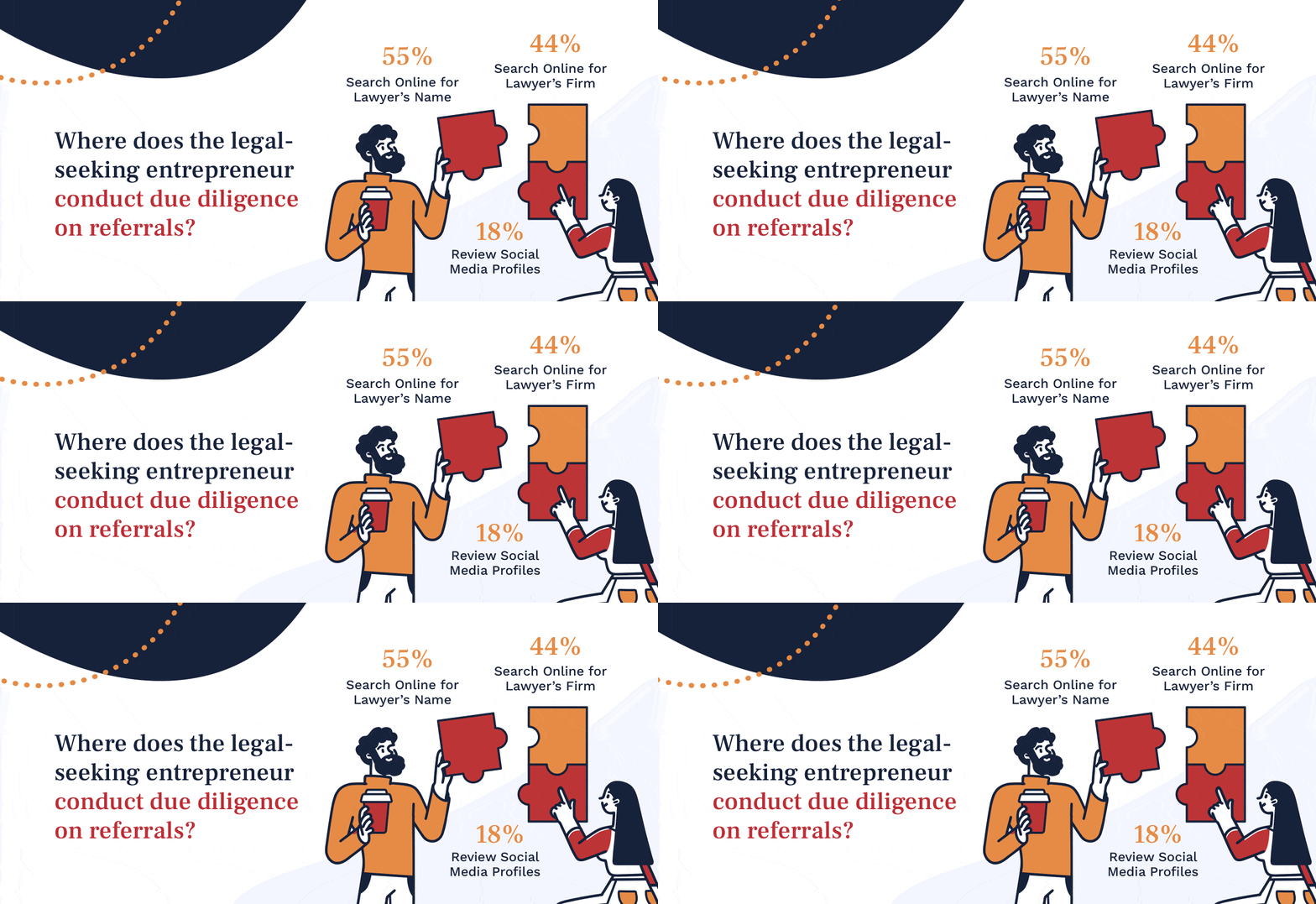
    But they may not make their decisions based on referrals alone; in fact, a large number of small business operators conduct due diligence on the lawyer recommended to them. More than half (55 percent) review search results for the lawyer’s name; 44 percent review search results for the lawyer’s firm.

    And a note of caution: A not-insignificant amount (18 percent) review the lawyer’s social media profiles. With this in mind, schedule a quarterly review of your LinkedIn page: Is it complete, accurate and relevant to your audience? Does it provide your contact information? At the same time, review the privacy settings on more informal social channels, such as X, Instagram and Facebook, to ensure new acquaintances only see what you want them to.

    When it comes to establishing credibility with this audience, the most critical and trusted tool is the lawyer biography, used by 92 percent of small business operators in their selection process. Among the other valued tools: online reviews (83 percent) and law firm content (72 percent).

    It’s interesting to note the shifting role that law firm content plays as a small business moves along its legal buying journey. Before an incident occurs, recall that 37 percent of these clients will browse law firm content. After, law firm content is cited as helpful to lawyer selection by nearly double that amount. This should be taken into account for law firm marketing strategies; what topics and types of content can help you close?

    For these individuals – potential small business clients with a specific need, actively shopping for a solution – the best content is practical. Instead of publishing Supreme Court updates or broad explorations of a given subject, think pragmatically, and focus on what can help them understand the process. This can include Frequently Asked Questions, definitions of relevant legal terms, a list of documents a client would need to get started, or a general timeline.

    Assuming due diligence goes well, nearly half – 46 percent – of small business operators will consider just one lawyer for their problem. And they act fast, with 60 percent hiring a lawyer within one week. Entrepreneurs move fast – and they want fast solutions to their problems. Law firms that are unresponsive or overly bureaucratic with Intake can risk losing this business to a faster, nimbler rival.

    What marketing strategies can help you win the business of small business?

    • Cultivate strong referral networks (and practice good referral karma). Make sure referrals are a key component of any coaching or business development training curriculum.
    • Be vigilant on your online profiles, from your biography to social media pages.
    • Have a proactive strategy to collect positive reviews, and keep an eye on sites like Avvo to address negative reviews.
    • Speed-test your Intake process to ensure you match your prospects’ sense of urgency.

    Up next: How to retain small business clients after that first matter.

    To learn how to attract, win and retain work from small businesses, download Firesign’s report, From Referrals to Recon: How Small Businesses Hire Lawyers.

  • How Small Businesses Hire Lawyers, Part 1: Before The Legal Need

    How Small Businesses Hire Lawyers, Part 1: Before The Legal Need

    From startups to multigenerational enterprises, there’s considerable opportunity for lawyers to serve small businesses – but little attention given to the demographic.

    Much of the legal press is concentrated on the largest corporations, but consider this: The average small business has 13 potential legal problems every year, and there are 33 million small businesses operating in the United States. Eighty-seven percent of those small businesses do not have in-house lawyers – meaning more than potential 373 million matters could be outsourced to law firms every year.

    How can you best connect with and serve these potential clients?

    While we found no shortage of surveys on in-house counsel or individual consumers, we struggled to find reliable intelligence on how small businesses hire lawyers – so we created our own.

    Firesign conducted a survey of 100 small business owners and leaders to learn about their buying behavior when it comes to lawyers and law firms. In this series, we will explore how they work before, during and after a specific legal problem arises.

    Part 1: Before A Legal Need

    It’s important to understand that small business operators are unlikely to engage with you before they need you. They are, after all, stressed and pressed: according to a survey by Entrepreneur, more than 40 percent of founders work more than 50 hours a week, and 41 percent feel stressed “pretty much every day,” with “never a dull moment.”

    They are not active consumers of legal news: Only 20 percent of respondents said they “frequently” educate themselves on legal issues, and 25 percent said they “never” do.

    They are unlikely to come to your conferences or webinars: Only 4 percent said they attend law firm educational events.

    So how do you reach them?

    Traditional media. Nearly half – 46 percent – said they learn about legal developments through trade publications that cover their industry; the same percentage said they read the general business press.

    Law firm content. Thirty-seven percent will read law firm content on a law firm website or through direct communication, such as a client alert. By contrast, only 4 percent use legal news aggregators, showing these tools are best for targeting other lawyers, from in-house counsel to referral sources.

    Social media. About one-third – 29 percent – look to platforms like LinkedIn to keep them abreast of relevant legal news.

    Interestingly, this order of preference is aligned with perceived reliability: Not only are news articles the most consumed, they are seen as the most trustworthy. Specifically, at 29 percent, trade media was seen as the most reliable news source. Law firm content followed at 26 percent Despite its popularity, content on general social media feeds was only viewed as reliable by 6 percent.

    We also asked small business respondents to provide any additional outlets they turned to for legal updates, and it’s worth noting that trade associations were mentioned multiple times.

    Key Takeaways: Marketing Before a Legal Need

    Do:

    • Pursue quotes and bylined articles in the media, especially relevant trade publications.
    • Post content on LinkedIn – and expect better circulation on lawyers’ personal posts versus the general firm account.
    • Seek opportunities to share your expertise with trade associations, which enjoy high levels of small business trust. Explore opportunities to speak and write for them.

    Don’t:

    • Assume small business operators are up to speed on relevant legal news. Provide context and recaps in your content.
    • Rely on events to reach this demographic; they are too busy.
    • Try to reach small business operators through legal news sites or syndicators.

    Up next: How to connect with small business clients when a legal need arises.

    To learn how to attract, win and retain work from small businesses, download Firesign’s report, From Referrals to Recon: How Small Businesses Hire Lawyers.

  • What Clients Want: Understanding A New Hierarchy of Needs

    What Clients Want: Understanding A New Hierarchy of Needs

    You’re likely familiar with Maslow’s hierarchy of needs, the famous and oft-quoted (and misquoted) psychological model that shows how human motivations evolve, starting with the physiological (air, food, shelter) and progressing to loftier goals of self-actualization (morality, creativity, fulfillment).

    Less well-known: Bain & Company’s Elements of Value pyramid, which similarly charts the four kinds of needs of humans buying goods and services. It’s a model that’s especially relevant for the legal profession, where it can be hard to achieve brand differentiation based on services; instead, by focusing on what clients value on a human level, law firms increase both revenue and loyalty.

    The Bain model includes 30 elements of value, sorted into four categories; starting from the bottom and moving up, they are:

    Category

    Values

    Examples

    Functional Help me do something better Save time
    Make money
    Reduce risk
    Reduce cost
    Reduce effort
    Emotional Help me feel better Provide access
    Enhance wellness
    Life Changing Improve my situation Provide hope
    Provide affiliation/belonging
    Social Impact Help me realize my best self Achieve self-transcendence

    As one climbs the pyramid, the emotional connection gets stronger – we feel the strongest about goods and services that affect our inner selves – but the marketing gets harder. (This makes sense: far more products are functional than life-changing.)

    After developing this model, Bain & Company put it to the test, and two of their findings are specifically relevant to law firms:

    • Loyalty: Companies that perform well on multiple elements of value have higher loyalty. Indeed, companies with high scores on four or more of the 30 elements, on average, outperformed companies with a high score in just one category by three times. For companies with no high scores? Twenty times.
    • Revenue: Companies that do well on multiple elements grow faster. Companies that scored high on four or more elements had revenue growth four times greater than companies with just one high score.

    And this isn’t accidental: As the Bain & Company researchers write in Harvard Business Review, “the winning companies understand how they stack up against competitors and have methodically chosen new elements to deliver over time.”

    Every day, law firms provide potential value – not in terms of summary judgment or letters of intent, but in real human emotions. Where we fail is to deliver it in a human fashion that connects with our human clients.

    How could law firms better position themselves using the Elements of Value? Consider these examples of purposeful execution:

    Functional

    • Reduces risk: Can you quantify your risk prevention and share that at the end of the matter? (And separate from the invoice?)
    • Makes money: Can you show how your work isn’t a sunk cost, but makes money? This is straightforward for contingency firms but just as possible after a creative settlement, licensing agreement, et cetera.
    • Reduces cost: What solutions have you brought (alternative fees, legal tech) that lower legal expense, and how can you quantify that?

    Emotional

    • Provides access: How could you leverage your firm’s contacts to help clients see that you expand their networks? This can look like an executive roundtable, an elected official meet-and-greet, a sneak peek at a new development project.
    • Reduces anxiety: If your primary goal was to reduce a client’s anxiety, how would that change how you communicate on budgets, matter status and more?

    Life Changing

    • Affiliation and belonging: Can you provide meaningful connections with peer groups? How do you validate new in-house counsel or new executives – and help them feel more confident in their roles?

    One note of caution: While these attributes (and others) are well within reach of law firms, the Bain & Company research team found that one attribute affects customer advocacy more than any other element. It’s quality, and “no other elements can make up for a significant shortfall on this one.”

    We’ve talked before about why law firm brands fail; two of the top reasons are focusing on features, not benefits, and telling, not showing. (“We have 100 employment lawyers” versus “Our employment lawyers handle retaliation claims like yours every day, and here’s our track record to prove it.”)

    The Elements of Value framework provides a helpful reminder that we are selling services to humans – even if they are humans working on behalf of international conglomerates – and can spark important ideas on how you serve and report to your clients.

  • Beware the 7 Deadly Sins of Law Firm Awards

    Beware the 7 Deadly Sins of Law Firm Awards

    For many law firms, it’s the thick of rankings season, as the third and fourth quarters bring a bevy of submission deadlines, from IP Stars to Legal 500 to Chambers USA.

    We pursue these programs – reputable recognitions that take into account casework, references and more – to build credibility in key practice areas and markets. (After all, according to Greentarget’s State of Digital and Content Marketing Survey, half of in-house counsel and 56 percent of the C-suite say these accolades matter when screening new outside firms.)

    So why don’t firms play to win?

    If you want to add a new ranking (or improve your standing for a current recognition), heed the Seven Deadly Sins of Award Season:

    One: Failing to read the directions

    First, let’s talk about deadlines. Most of these programs publish their schedules months in advance. This is not for their own enjoyment; they have production schedules of their own. Submit your entry on time; if there’s a true extenuating circumstance, communicate it as soon as possible, but don’t bank on any favors. (Even if you’ve gotten an extension before.)

    Now for the submissions themselves: While many foundational elements of these award programs remain the same year after year, occasionally there are little adjustments – the number of references allowed, a new word count limit, a question added or subtracted. Don’t make any rinse-and-repeat assumptions. Review the submission template and any accompanying instructions before you start. (Many programs are offering educational webinars when they kick off the submission process; again, they do not do this for their own enjoyment. By attending, you’ll learn about any new tweaks, save yourself from having to ask a silly question…. and maybe get some karma points.)

    Reading the directions is especially key for rankings programs that take submissions through portals. Confirm your log-in and test it early. Do not wait for 5 p.m. on the day your material is due to find out your log-in has expired (or worse, that there’s a brand new portal in place).

    Two: Failing to make a case

    Too many law firms cut and paste milquetoast practice group descriptions into award rankings. This does not help you stand out from the stack of submissions at all. In fact, most (if not all) of your competitors can say the same things: a deep bench of experienced lawyers, a variety of clients spanning myriad industries, an enviable record of success…

    We all know that song.
    Do not cut and paste your marketing boilerplates into your submission. Instead, review the award and category criteria, and draft straightforward language that speaks directly to the editors.

    Start with a sentence like, “Pearson Specter merits ranking in ___ category for three reasons,” then list your arguments. (Don’t have three arguments? This may not be the right ranking.)

    Three: Failing to make your work relevant

    This next point is critical if you are competing for a state or regional ranking that will be evaluated by a judge outside the U.S. (For example, you are pursuing a Chambers ranking for real estate in Illinois.) You must put yourself in the role of the editor – someone based in London, who has no idea about your local market – and educate.

    Perhaps Wayne Enterprises is a household name in your city/state/region. Do not assume that the company name means anything outside the U.S. Whenever you mention the client, make it relevant: “We serve as the primary real estate counsel for Wayne Enterprises, a chemical, shipping and manufacturing conglomerate that operates 140 facilities across the country.”

    Make sure you do the same for results, too. Acknowledge that the editor may not be an expert in the field of law – but certainly is reviewing dozens of lookalike submissions. Write your results so they are lively, accessible and meaningful. Instead of “Advised Wayne Foundation on construction of new headquarters in Gotham City,” add details that make the story real: “Advised Wayne Foundation, the largest private foundation within the DC Universe, on construction of new headquarters. The complex transaction involved a public-private partnership with Gotham City and unique zoning considerations due to an underground bunker that houses Batman’s Subway Rocket vehicle.”

    Four: Failing to account for the competition

    While you should never disparage other firms (in your submission or the interview), you should review the landscape and prepare key points on how you stand apart from the pack. While some “tale of the tape” metrics, like headcount, can be helpful, it’s more fruitful to dig into metrics of the legal work.

    What are the quantitative measures that show your dominance? Have you handled more litigation matters in a given jurisdiction than your competitors, filed more patents, et cetera?

    What are the qualitative measures that show your quality? Are any of your matters the biggest, the first, precedent-setting?

    If you are a boutique going for an award that has only gone to mega-firms so far, don’t be afraid to stand up for your peer group: “While we recognize the excellence of the firms recognized to date, we would call your attention not only to our firm, but to other outstanding specialist firms, including…” Naming a few other firms worthy of a look can help you garner a few more karma points.

    Five: Failing to present a team

    Award editors, like your clients, know that most legal matters are not resolved by one-man bands. For programs that ask for the names of individuals on a given project, provide all of the lawyers involved, including associates.

    While promoting solo acts might help that lawyer get listed, presenting a limited roster can hurt your chances for a firmwide ranking.

    Six: Skimping on references

    While the firm information and representative casework are important, so many of these award programs hinge on market feedback. Supply as many references as you are allowed. Select references for responsiveness, not clout: An in-house paralegal who will participate in the process is worth far more than a general counsel or CEO who will not.

    Don’t surprise your references, either. Obtain permission, and manage expectations in terms of who will be contacting them, when to expect this outreach, and what will be covered. (If this is not clear on the award’s website, ask – the editors want and need reference participation, too.)

    Mind “reference fatigue,” and try to avoid listing the same references for awards with similar timelines. If you are running short on references, some publications will allow you to list other outside counsel familiar with your work – and many peers will appreciate a reciprocal reference relationship.

    Seven: Failing to follow up.

    Most award evaluation cycles span several months. So again, while it is critical to meet the deadline, don’t assume any news that happens afterward is moot.

    If you have significant news to share – a new case win, a reputable lateral, an acquisition – send it along to the relevant editor. (Make it easy for them to connect the dots; I like to use “Update: Firm Name: Jurisdiction – Practice Area” in the subject line.)

    For some awards, the submission is just the start. Next, there’s an interview, reference calls, you name it. Meet the deadline, but don’t stop there: Maximize your chances of a win by staying accessible, responsive and respectful.