Category: Industry Insights

  • Want a Great Brand? You don’t get to be Batman.

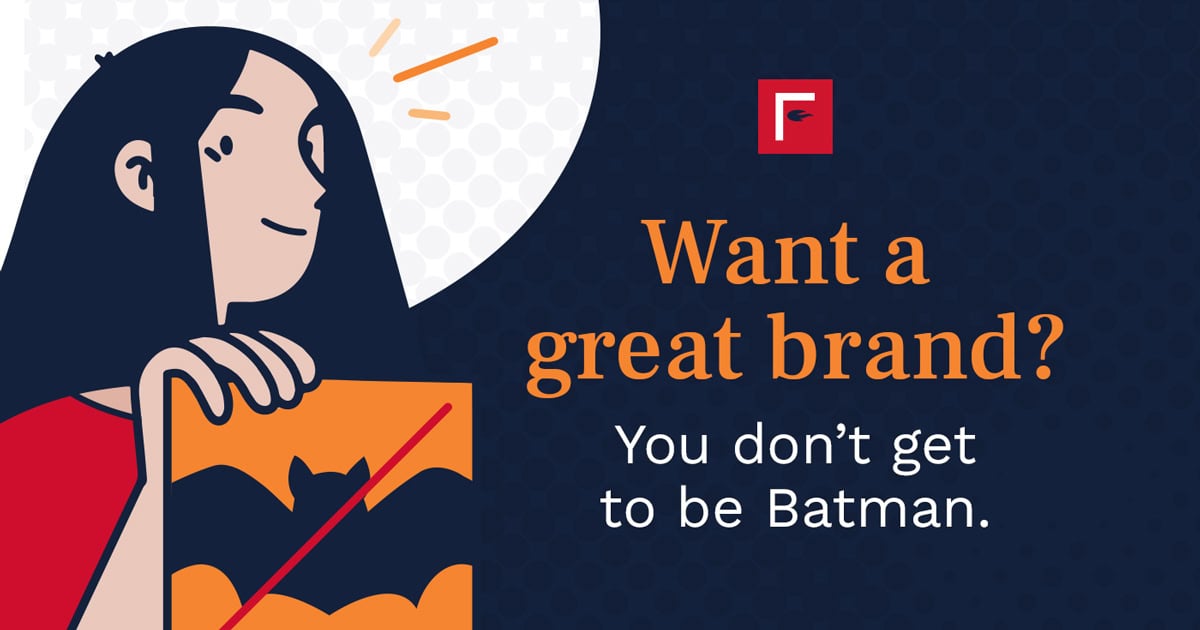
    Want a Great Brand? You don’t get to be Batman.

    I get it, we all want to be Batman. (According to various sources of internet lore, up to 97 percent of men think they are Batman.)

    But if you want a smart brand for your law firm, it may be time to hang up your cape.

    Background

    This fall, I’ve been collaborating with Jesse Wroblewski of Decommoditized for a series of presentations on how law firms can differentiate themselves.

    At each conference, we ask the audience to think of the ideal spokesperson for their firm. There are no constraints: The person can be long dead, the person could be fictional, the person could be prohibitively expensive.

    We’ve gotten some great answers, ranging from Andy Griffith to Queen Elizabeth II, but perhaps the most important takeaway for me has been what I now call the Batman Principle of Branding.

    Jesse had worked with a law firm that, in the same exercise, chose Batman. Again, who wouldn’t want to be Batman? The look, the voice, the toys, I get it.

    The problem: The firm wasn’t Batman. The firm was Alfred.

    The Batman Principle of Branding

    Put coolness aside. What would make Batman a good personification of a law firm? He’s unreliable. He keeps weird hours. He has a host of relentless enemies. Half of Gotham jurors think he’s a villain.

    Meanwhile, there’s Alfred: Calm, smart, reliable. Alfred keeps secrets, maintains order, makes sure you’re in the right place at the right time.

    Most of all, Alfred isn’t trying to be the hero: Alfred empowers Batman to be the hero.

    This brings us to the Batman Principle of Branding: Your clients don’t want you to be Batman. They want you to help them be Batman.

    If you serve corporate clients, you are working with in-house counsel; these are smart and talented lawyers whose positions (and compensation) rely on them being the hero to the C-suite.

    If you serve consumers, many are in precarious life situations: facing criminal charges, experiencing domestic upheaval, recovering from a serious injury. Psychologically, they need and want to take charge of their own lives.

    Consider the formula popularized by StoryBrand: A character (your client) has a problem and meets a guide (that’s you) who gives them a plan.

    The Argument for Alfred

    Notably, StoryBrand advises: “What people really care about is their own story. When your brand stops playing hero and starts playing the role of guide in your customer’s story, you’ll see dramatic results.”

    Let’s go back to the personification exercise. The specific goal of this work is to develop a character who can represent your firm. It’s a hypothetical exercise: You will likely not use this individual in advertisements or Instagram posts, but by personifying your firm, you can ensure that your brand voice – how you write and present – is clear, consistent and effective at connecting with your target audience.

    To demonstrate the difference between a Batman and an Alfred, try out some of your firm verbiage on ChatGPT.

    Let’s look at some familiar language: “Past results do not guarantee future results. Every case is different and should be evaluated on its own merits.”

    From Batman: “Victory isn’t a promise — it’s a battle fought in the shadows, one case at a time. Every fight is different. And nothing is ever guaranteed.”

    From Alfred: “While past successes are commendable, they’re no guarantee of future outcomes. Each case is unique and deserves its own careful attention. But with the right approach, there’s always hope.”

    You can see the difference — but you can also feel the difference.

    The Alfred voice is more professional and reassuring, and it turns out that this can have compelling benefits for your firm beyond slick communications. While firm positioning can vary widely, most human beings respond better to a tone that’s reassuring and professional. Indeed, according to research we’ve discussed previously, 82 percent of client sentiment is driven by two factors: warmth and competence.

    The interplay of warmth and competence results in an emotional response of “admiration,” leading to attraction, affiliation and alliance — and long-term benefits of repeat business and referrals. Meanwhile, Batman’s cold competence results in mere “obligatory association.” Even the clients who seek out a “bulldog” for the courtroom won’t stick around for additional matters or Avvo reviews.

    Alfred in Action

    When lawyers adopt the Alfred position — a smart, sharp resource ready to help the client vanquish the villain — they can deliver the kind of selfless service that gets remembered.

    Years ago, I worked with a lawyer who helped secure a massive recovery from a corporate client’s insurer. The money was set to come in at the end of December. Instead of having the insurer wire it, this lawyer had the insurer cut a check — and then he flew the check to the corporate headquarters.

    He then gave the check to the in-house lawyer, so she could deliver it to the CFO. She got to deliver a multimillion-dollar check that boosted the company’s fourth quarter. She got to be the hero.

    As Commissioner Gordon might say, that’s the lawyer that Gotham deserves.

    Holy Brand Voice, Batman!

    The personification exercise is such a fun, powerful way to determine how your firm will present itself to your potential clients.

    Get creative, but heed the Batman Principle of Branding: Is your ideal spokesperson stealing the glory from your client?

    If your first answer is a hero figure, a powerful protagonist or a main character, think: Who’s the person behind this person?

    Maybe you’re not Jed Bartlett; maybe you’re Josh Lyman.

    Maybe you’re not Taylor Swift; maybe you’re Tree Paine.

    Maybe you’re not Michael Jordan; maybe you’re Scottie Pippen.

    Let the client take the spotlight, and you’ll have far more Bat signals to answer.

  • Who Cares About Law Firm Branding?

    Who Cares About Law Firm Branding?

    Your short answer may be “not me,” and that’s fine. Lawyers don’t have to care about branding — but the most successful ones recognize that their audiences do.

    Indeed, branding resonates with the people who matter most to your firm’s success, among them:

    Business Clients

    Whether it’s “boardroom cover” or simple affinity, Thomson Reuters reports that law firms with “strong, favorable brand perceptions” earn an average of 38 percent more of their clients’ external legal spend.

    Thomson Reuters uses the example of Baker McKenzie. When asked to simply name law firms — a pure open-ended question — more than 18 percent of global legal buyers named Baker McKenzie. Then, later, 80 percent said they consider the firm for their cross-border litigation needs.

    Simply put, the firms that stay top-of-mind get more opportunities.

    Consumer Clients

    Perhaps your clientele is more on the consumer side. Here, branding also matters, and as Clio’s Legal Trends Report shows, there’s an interesting breakdown along generational lines.

    Nearly half — 45 percent — of Gen Z clients care about a firm’s brand and image, followed by 36 percent of Millennials. That number drops to 28 percent of Gen X and 19 percent of Boomers.

    Specifically, for these rising clients of tomorrow, your online brand presentation is key:

    • Gen Z and Millennial clients care more about a lawyer’s website (49 percent and 48 percent, respectively) than Gen X and Boomers (34 percent and 21 percent, respectively).
    • Gen Z and Millennial clients are nearly twice as likely to value online reviews.

    Meanwhile, Clio’s numbers start to show the traditional pipeline of referrals may be slowing: While referrals are valued by 60 percent of Boomers and 56 percent of Gen X, that drops to 46 percent for Millennials and 47 percent for Gen Z.

    It’s important to note the oldest members of Gen Z are now nearing their late twenties. These are no longer the “clients of tomorrow”; many are your prospects of today.

    New Hires

    Both lateral partners and new associates seek out employers with established, professional brand identities.

    Lateral partner candidates shop around, as demonstrated by research from mega-recruiter Major, Lindsey & Africa. Two-thirds consider more than one firm, with 29 percent scouting four to five and 9 percent reviewing a whopping seven or more.

    These moves aren’t always motivated by a desire to “swim upstream”; 44 percent will go to a firm with similar or lower profitability. What does move the needle? While brand wasn’t a specific option in the survey, it manifests in two of the top three answers:

    • Practice support, including marketing
    • Effectiveness of management
    • The firm’s culture and reputation

    (For the record, “anticipated compensation” ranks sixth.)

    Meanwhile, if you plan to hire associates, take heed: In a survey of summer associates by the National Association for Law Placement, nearly half — 47 percent — of respondents said that if given two or more offers, they based their decision on the “reputation, ranking or prestige of the firm.” This outpaced firm culture (41 percent), type of work (33 percent), location (27 percent) and compensation (13 percent).

    And on a less human, but no less impactful note:

    The Bottom Line

    Altman Weil cites a United Kingdom study that concluded brand recognition in professional services firms is worth a 10 to 20 percent premium in fees.

    Law firms with strong brands will get more opportunities in the market; position themselves more effectively to capture work from future generations; attract quality laterals and new associates; and make more money.

    Harnessing the power of effective law firm branding doesn’t hinge on having the size and scope of Baker McKenzie (or even a fledgling interest in fonts). The journey to a strong law firm brand just takes many of the skills your legal career already has cultivated: You will call upon your ability to strategize to define a position; your ability to persuade to claim it; and your ability to make a case to provide evidence you’re the best choice.

    Ready to get started?

    Here’s some introductory reading:

    The Basics of Branding (and How Law Firms Mess It Up)

    Discover the common branding mistakes law firms make and learn how to avoid them. Is your firm’s brand set up for success?

    Read More

    Why Clients Like — and Refer — Law Firms

    Discover the common branding mistakes law firms make and learn how to avoid them. Is your firm’s brand set up for success?

    Read More

  • Five Signs You Need a Law Firm Marketing Audit

    Five Signs You Need a Law Firm Marketing Audit

    It’s nearly unanimous: 95 percent of law firms say that because marketing is a non-billable expense, the spending risk is greater, according to a CallRail survey.

    But despite this inherent risk, many law firms take a somewhat scattershot approach. Some might chase the next big thing, and others may stay with what’s worked in the past, but neither are analyzing results beyond the anecdotal level — or taking corrective action.

    To wit: In the same CallRail survey, respondents ranked social media as the No. 1 most valuable channel for lead generation…and they also ranked social media the No. 1 worst performer. “Almost every channel was considered underperforming by almost 20 percent or more of law firms,” CallRail noted.

    With the average law firm marketing budget clocking in at 7 percent of revenue, it’s worth taking the time to make sure your marketing activity is getting the right results. Just as financial audits ensure accuracy and detect problems within your firm’s books, a marketing audit can shine a light on what’s working well, what’s not, and how you can adjust for better ROI.

    What is a marketing audit?

    No two firms are alike; a family law practice will have a different marketing mix than a corporate firm. While the tactics may be different, a law firm marketing audit should examine activity, spend and results in three main categories: attracting business, winning business, and retaining business.

    Attracting business

    Within its particular ecosystem, how effectively does the firm get itself in front of potential clients and referrals? What is the strength of its brand and marketing materials? Is the website attractive, user-friendly and search-optimized? What is its share of voice in key publications? How well does the firm and its lawyers use social media? How competitive is the firm in credible industry rankings?

    Winning business

    When the firm has a specific opportunity to serve a specific prospect, how well does it close? How does it present capabilities in pitches and proposals? What are the patterns for business won and business lost? What messages are particularly effective? Who does the firm lose business to, and why?

    Retaining business

    How well does the firm keep and grow its current clients? What kind of outreach does the firm maintain between matters (and invoices)? How does the firm reach out to former or inactive clients? How does the firm obtain and act upon client feedback? What is the state of the firm’s current online reviews?

    A helpful marketing audit will not only dive into topics like these, it will synthesize findings into recommended actions, sorted by priority and timeline. We like to start each audit with a color-coded overview — similar to what you get at a car tune-up — that shows at a glance what’s working well (green), what could use some adjustment (yellow), and what needs attention now (red).

    When do I need one?

    While in a perfect world, law firms could take time every year to do a deep dive into their marketing, perfect need not be the enemy of the good; there’s significant value in sporadic reviews.

    It’s a great time to do a marketing audit if:

    • You’re not sure how to get started: Maybe you just launched your firm, or maybe you’re looking to grow business beyond your immediate network. A modified marketing audit can help you prioritize your time and spend.
    • Your firm has changed: Maybe you merged with another firm, opened a new location or added a large new practice area. When your service offering shifts, your marketing mix should too.
    • Your phone isn’t ringing: If you’ve experienced a dropoff in the quantity or quality of client queries, diagnose the actual problem before pivoting (or continuing to throw good money after bad leads).
    • You’re in the midst of succession planning: If some of your most high-profile rainmakers are preparing to retire, a marketing audit can help you understand where that might leave you vulnerable – and what kind of messaging and outreach can position you for a smooth transition.
    • You don’t know what’s working: If you are spending 7 percent of your revenue (or more!) on marketing but aren’t sure what it’s doing for you, a marketing audit can help you establish benchmarks with peers, set metrics for your firm moving forward, and ensure your spend is productive.

    Note that audits need not be firmwide, either; specialty practice or industry teams can audit their group’s marketing activity separate from the macro firm.

    Think about planning your marketing like you do your healthcare. Before you spend money on a treatment plan, you’d want to make sure you were accurately diagnosed to begin with (and no, the marketing equivalent of WebMD does not count). This means reviewing your history, asking some detailed questions and running a few tests.

    Again, 95 percent of lawyers view marketing spend as inherently risky. Marketing audits will help you lower your risk and increase your ROI through a thorough diagnostic process and a proper prescription.

  • Starting Your Own Firm? Three Costly Marketing Mistakes to Avoid

    Starting Your Own Firm? Three Costly Marketing Mistakes to Avoid

    Sitting square among the AmLaw 200 is Boies Schiller Flexner, a litigation boutique that not only boasts annual revenue of $246 million, but also is a role model for the aspiring entrepreneurs working in Big Law.

    It all started in 1997. David Boies was a partner at Cravath, Swaine & Moore, and according to Wikipedia lore, a major client objected to his representation of the New York Yankees. Boies left within 48 hours to start his own firm.

    Three decades later, Boies Schiller is still a litigation boutique…but one that reports 153 total lawyers, 13 offices and $2.5 million in profits per partner. (And the entrepreneurial beat goes on: As Boies Schiller itself became Big Law, it has spawned at least one spinoff firm of its own.)

    While the scale of Boies Schiller may be distinctive, the origin story is not unique: Every year, Big Law lawyers leave to open their own shops.

    And these attorneys — who are accustomed to Big Law marketing resources and on-call expertise — often find themselves cobbling together DIY solutions or chasing short-term solutions that bring long-term consequences (and expense).

    If you’re considering hanging your own shingle, here are three marketing pitfalls to avoid:

    Losing Logo Rights

    Your new firm needs a logo. And while it need not be a break-the-bank expense like CitiBank’s $1.5 million mark, it must be one that you fully own.

    Startup law firms can get into trouble in several ways:

    Crowdsourcing: Websites like 99 Designs, for example, allow you to conduct logo design contests. Freelancers submit ideas, you pick a winner, they get paid. How do you know your logo doesn’t infringe on anyone else’s copyright or trademark? You don’t. (The company states it clearly: “The onus is on you.”

    Canva: The DIY website Canva makes millions of design elements available. Some are free, some require a small monthly fee. The website says you can “customize your logos with our library of vectors, graphics, icons and illustrations.” Read that carefully: Your logo, our library. Canva maintains all intellectual property rights to these images, so it effectively owns your logo.

    Moreover, Canva is indeed a library — so if you use a Canva icon in your logo, there is nothing to stop anyone else from doing the same. You have zero resource for infringement if the same icon is adopted by the law firm down the street (or worse).

    Contracts: If you make the correct choice to use a qualified designer to make you a custom logo, ensure your contract states that you own the final product. Look for language like “All work created specifically for Client under this Contract shall be considered ‘work for hire’ and all intellectual property rights are owned by the Client upon full payment.”

    What to do

    Hire a designer with experience and expertise in law firms — and ideally the type of law you practice. Emphasize that your logo must be proprietary and ownable. Enforce your IP rights with smart contract language.

    Renting, Not Owning, Your Website

    It sounds promising: For a reasonable monthly fee, Company X will host, design and update your website. No effort needed on your part; no cash outlay required.

    The problem

    In many of these arrangements, you don’t own your website — you’re basically “renting” it from the company. If you ever want to switch, you’re out of luck. They may own your URL (i.e., www.firesignmarketing.com), so if you want a new site, you have to start over with a new name…and fight with them to take down the old one. (And have fun changing your email address everywhere.)

    They may also use a proprietary content management system (CMS), the back-end software that runs and renders the website itself. And some of these work really well! But when it’s proprietary to the company, only that company can make back-end changes. You can never hire another agency or freelancer to update your site; you are a hostage to their CMS.

    One final cautionary tale

    We have seen law firms hire agencies that do not give them access to their site at all — and yet empower these agencies to draft and post informational content, like blog posts. If an article is factually incorrect or counter to the firm’s position, the lawyers have to navigate a draconian customer service process to have it removed.

    Lawyers leave. Typos happen. Laws change. You must have access to your site; you must be trained to make basic changes; you must know that at any point you can find another resource to manage your site.

    And you absolutely must own your URL.

    What to do

    As soon as you decide on your firm name, purchase your URL through a reputable source like Network Solutions, HostGator or GoDaddy. Then, take the time to find a website designer that prioritizes your ownership of the site itself — and your long-term access to it.

    It’s smart to build your site on WordPress. It’s a CMS that is flexible enough to accommodate your design preferences but common enough that it will be easy to find someone to help maintain the site (or to find a YouTube tutorial to guide you through basic updates).

    With any designer or agency, again, insist on full ownership of the site through smart contract language. And pay in full for it; most agencies will allow payment plans for startup firms, and in a couple of years, buying your site will prove more cost-effective than renting.

    Going with a Generalist

    Within your network, you probably know a dozen marketers, and most of them are likely very talented. Yet how many will start with a solid base of knowledge in your practice — and more critical, a thorough understanding of lawyers’ ethical obligations? Well-meaning and talented marketers can (and have) mistakenly include forbidden terms like expert, specialist or guarantee…and when you’re busy opening your firm, you may miss these transgressions.

    Engaging a marketing generalist can actually result in more work for you, as you will need to spend more time educating them on your services and market (or rewriting their material). And it won’t matter to the state bar association if your website is beautiful or innovative if it violates the Rules of Professional Conduct.

    What to do

    Seek marketing help that specializes in legal. We recognize that before you’ve launched your firm, your plans may be confidential; you are not in the best position to ask around for recommendations. If you’re not sure where to start, check out marketing articles on industry sites like JD Supra or review industry accolades, such as the Lawyerist’s Best Law Firm Websites roundup.

    Find an agency with a point of view that corresponds to yours. Ask to see examples of their work, and ensure they have a proven process that will keep your projects moving forward.

    There’s a lot more to do, of course — from nailing your brand positioning to crafting compelling evidence that your new firm is a safe, reliable choice. But starting out with clear ownership of your key marketing assets and true expert help will save your startup significant time, money and heartburn. (And just might help you create the next Boies Schiller.)

  • How GCs Will Choose Law Firms in 2024

    How GCs Will Choose Law Firms in 2024

    It’s not your imagination: Legal business development in 2024 is harder.

    In a January survey by BTI Consulting, 53 percent of lawyers and law firm leaders said business development would get harder this year. And it’s worth noting that among the 47 percent who said it would not, one of the primary reasons was “It’s already monumentally hard – it can’t get any harder.”

    When the market feels tight, it’s imperative to take a closer look at buyer behavior. For corporate law firms, that means understanding what types of matters general counsel are outsourcing (and what they are not), and what law firm intangibles are part of their criteria.

    Let’s dive in.

    Budget cuts prompt insourcing, shopping around

    Nearly 70 percent of general counsel are under “moderate to significant” cost pressure from their business leaders, according to Thomson Reuters’ 2024 State of the Corporate Legal Department.

    To meet that challenge, 68 percent plan to bring more work in-house. Specifically, that will include:

    Contracts Litigation Corporate Compliance Transactional M&A
    22% 16% 14% 9% 7% 5%

    In addition, nearly half – 48 percent – said they are looking to move work to less expensive firms, and 22 percent are considering alternative legal service providers. The matters affected:

    Litigation Transactional Contracts Corporate M&A Compliance
    39% 13% 11% 11% 7% 4%

    Law firms who hold onto their work should expect more aggressive negotiations; 67 percent of respondents plan to seek additional rate discounts, and 52 percent want alternative fee arrangements.

    What this means

    Litigators should be on alert: More than half of respondents are looking for new solutions.

    For Big Law, it’s time to play defense; start proactive outreach about rates, value and new fee options.

    For more nimble boutiques, go on the offense: While we would never advocate selling on price alone, get aggressive with your visibility, credibility and networking. In-house departments will be increasingly receptive to proposals that lower their spend and make their lives easier.

    Secondary factors matter

    Beyond expertise and value, how are GCs scouting and selecting firms? The Thomson Reuters survey also asked which law firm traits mattered – and to what extent. Respondents rated these as “mandatory” for their legal providers:

    Firm purpose and values Use of appropriate technologies Transparency in AI use Diversity within the firm Firm carbon footprint
    25% 20% 14% 14% 5%

    When combined with the next category, “not a specific requirement but considered as a part of decision-making,” we can find new priorities for firm marketing. These are especially important for the boutiques who may look to capture new clients in 2024 – and who may not have yet addressed these topics.

    Firm purpose and values

    These will be considered by 74 percent of in-house counsel. Do you have an authentic, relevant purpose statement? (And can you back it up?)

    Use of appropriate technologies

    This matters to 72 percent of potential clients. Beyond a laundry list of the software you use, work to show how you use it: It’s time to draft case studies that show efficiency and effectiveness.

    Diversity within the firm

    71 percent of legal teams will evaluate your firm on its diversity, equity and inclusion efforts. Many in-house counsel understand that your demographics may not be perfect; they are looking for well-rounded teams, purposeful efforts, and a lack of red flags. From a marketing perspective, do you use inclusive language? Is your website ADA-compliant? Do you have progressive policies for your lawyers and professional staff, and do you invest in positive change?

    Transparency in AI use

    This is one to watch. In 2024, transparency matters to 34 percent; it’s likely this will go up in the coming years. The phrasing here is key: Clients are not mandating AI use, but they want to know where you stand. Decide what you will (and won’t) allow, commit to it, and communicate it clearly. (When asked by the American Lawyer in January, about 30 of 100 shared clear AI policies.)

    Firm carbon footprint

    This is on the radar for 34 percent, but Thomson Reuters notes that this is a mandatory requirement for about 20 percent of United Kingdom-based legal departments. When data is adjusted for the U.S., this is only considered by 20 percent of respondents, making it a long-term issue (for now).

    Again, business development feels a bit tougher in 2024. The law firms that will prosper in a tougher climate are those who will position themselves effectively when it comes to value, either through creative offense or smart defense; those with well-defined brands that are relevant, authentic and ownable; and those who translate concepts like “use of appropriate technologies” into compelling case studies that show a better client experience.

  • Process Models, FAQs: Close More Clients Through Clarity

    Process Models, FAQs: Close More Clients Through Clarity

    Imagine this: You hurt your knee, and you’re scouting orthopedic surgeons.

    The first doctor you see tells you “Every knee is different, I’ll just have to open you up and go from there.” When you ask how long recovery may take, he shrugs: “It depends.”

    The second doctor, meanwhile, takes out a 3-D model of a knee joint and shows you exactly where she would cut. When you ask about recovery, she discusses the factors that could affect the timing—swelling, reaction to anesthesia, complications, pre-surgery fitness, et cetera—but then says that based on her experience doing exactly this type of surgery, she estimates six to eight weeks. She leaves you with a pamphlet that shares what you’ll need to do before and after surgery.

    Which doctor do you choose?

    Your prospective legal clients are in the same situation—and while the injury may not be as literal as a torn meniscus, they are seeking reassurance from an experienced expert.

    Indeed, in a Clio survey, 70 percent of legal clients said they want a clear understanding of the legal process and what to expect—more than the 66 percent who want a total cost estimate.

    While every case is different and should be evaluated on its own merits, the lawyers who can manage expectations in the scouting stage will be better positioned to get hired—and may also find themselves with more educated, engaged clients.

    Consider taking these three steps:

    Illustrate your common processes

    Creating an ESOP or filing a contract dispute may be second nature to you—but it’s not for your client. Distilling the key steps into a one-page infographic provides a powerful visual and helps the client understand both every step and the big picture.

    Documenting a “Proven Process” is a critical component of the Entrepreneurial Operating System, or EOS, which advises: “It’s your process that has proven over and over again to provide consistent, predictable results. And when shared with prospective customers, their questions and hesitancies are alleviated.”

    EOS recommends:

    • Tell the client their story and what it will be like to work with you.
    • Make it visual with very few words.
    • Communicate the process in five to seven milestones.

    Law firm example: AEON Law, an IP boutique in Seattle, posts its Trademark Process on its website. Potential clients can see the main steps involved, from Discovery to Registration to Monitoring.

    Help clients prepare

    Do you find yourself answering the same questions repeatedly? Do you regularly need the same types of documents or information?

    Make the beginning stages of a matter easier on both you and the client by offering some guidance. Most clients want to feel in control, and want to be actively working to advance their cause; help translate their nervous energy into action with education and direction.

    Posting your answers to Frequently Asked Questions on your website may eliminate some back and forth (and provides a resource that clients can look back to if and when they forget part of your discussion). And giving clear homework assignments may allow for a more efficient and effective kickoff meeting.

    Law firm examples: Fisher Law, a family law firm in Kansas City, clearly tells clients to “bring this form to your initial meeting.” Astley Putnam, a family law firm in Omaha, has a “How to Get Started” page with helpful FAQs.

    On the corporate side, SECIL Law, a white-collar criminal defense and securities law boutique, categorizes its FAQs by client type, so visitors can self-identify as a Company Owner, Financial Advisor, and more.

    Show you’ve been there.

    In the same Clio survey, 77 percent of prospective clients said they want to know a lawyer’s experience and credentials, and 72 percent want to know what types of cases they handle.

    Again, every case is different, but how can you show you are a safe choice for this type of problem?

    • Ensure that your bio is up to date with relevant content and representative work highlights.
    • Pursue awards and rankings that provide third-party endorsement of your capabilities.
    • Draft thorough case studies (with client permission!) that allow your prospects to see themselves in your results. These should go beyond the “Handled matter for client” bullet point to explain the situation, stakes and solution.

    The Clio survey provides one last compelling argument as to why law firms should prepare these types of marketing materials: Failing to do so can lose you business.

    Clio asked survey respondents why they did not hire a lawyer they reached out to, and nearly two-thirds, 65 percent, didn’t get any indication on what to do next; another 62 percent didn’t understand the process for their case; and 61 percent didn’t get information they could understand.

    Let’s revisit the orthopedic surgeon analogy. Lawyers who take the time to elevate their bedside manner with models and educational materials will be better positioned to close—and better connected to informed, proactive clients.