

Law firm branding can present a paradox: There’s a contradictory conventional wisdom that clients want relentless gladiators in the courtroom or boardroom….who also happen to be extraordinarily nice, responsive and service-oriented outside of it.
It’s a tall order, and the effort to do both results in weak law firm brands. Firms that try to be everything end up standing for nothing; firms that try to switch gears from aggressive to cuddly suffer from split personality syndrome.
As you consider the identity you – as a human or a firm – present to the marketplace, it’s helpful to understand what we as human beings are programmed to favor, as well as the emotions most often at play in legal matters.
Or, to make it simple: Should you smile or smolder in that bio photo?
Two Universal Brand Drivers
While there are myriad facets of brand identity, it turns out there are two that account for 82 percent of client sentiment.
These elements – warmth and competence – were confirmed over 10 separate studies by Chris Malone and Susan Fiske, and reported in The Human Brand. These two characteristics govern our judgments of the world around us, including individuals, groups of people, teams, companies, nations, brands….and yes, law firm brands.
What’s behind them:
- Warmth: We quickly evaluate whether an entity is kind, friendly and good-natured; whether it appears sincere, honest, moral and trustworthy; and whether it is perceived as helpful, tolerant, fair, generous and understanding.
- Competence: As the authors describe it, “How successful would they be in carrying out their intentions toward us? … Do they appear efficient, capable, skillful, clever and knowledgeable? Do they possess the confidence and ability to carry out their plans?”
The interplay between the two is significant: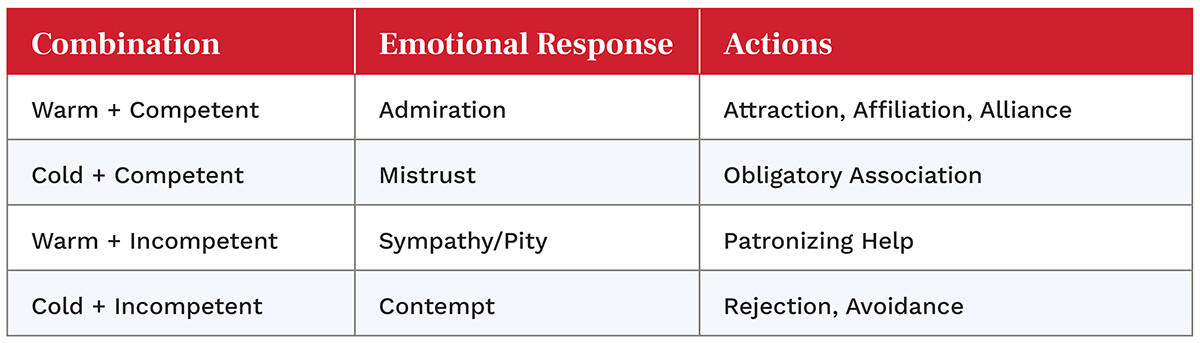
In the pursuit of brand loyalty, Warm + Competent is the clear winner, sparking attraction and affiliation. Law firms should note with caution the combination of Cold + Competent, which results in “obligatory association” – and client flight risks.
Moreover, law firms that are viewed as both warm and competent may have a bit of an insurance policy against the occasional mistake (or loss in litigation). As Malone and Fiske note, “When companies held in high esteem for warmth and competence make errors and stumble, they are able to recover from those errors, building even more genuine, trusting and lasting relationships with customers.”
While warmth and competence are said to be universal – governing our thoughts on everything from pets to basketball teams – it’s helpful to check their applicability in the specific legal context.
Harvard Law School’s The Practice shared research into the brand drivers specific to law firms – the qualities that lead clients to select, stick with and recommend their lawyers. The top three:
- Expertise: “The quality, specialist knowledge, star individuals, breadth of services, or results achieved.”
- Service: “Responding quickly, being available and accessible, and generally giving high levels of client service.”
- Relationship: “A true partnership that is highly valued by both sides.”
Expertise, service and relationship – in other words, competence and warmth – bested all other themes, including business savvy, geography, style, value and reputation.
Advocating with Empathy: Understanding Client Emotions
It’s helpful to acknowledge exactly how and why warmth matters in the legal setting – particularly when considering the perception that many clients want “bulldogs,” not BFFs.
Too often, attorneys do not understand their clients’ emotional state, according to a Clio survey of both lawyers and clients.
The survey asked clients to list their feelings about their legal problems, then asked lawyers to guess which feelings came into play. Interestingly, lawyers accurately predicted that clients can feel anxiety, control, annoyance and anger. However, lawyers missed five others.
Lawyers underestimated four key feelings:
- Relief: While 51 percent – more than half – of clients feel relief to address and resolve a problem, only 17 percent of lawyers named this as a potential emotion.
- Frustration: 40 percent of clients feel frustrated, yet only 8 percent of lawyers guessed it.
- Urgency: 33 percent of clients want fast answers; only 15 percent of lawyers perceive that.
- Disbelief: One-quarter of clients may feel shock or denial, yet just 11 percent of lawyers could foresee it.
Meanwhile, lawyers vastly overestimated their clients’ potential for confusion: Nearly half (45 percent) of attorneys guessed that their clients were befuddled by legal proceedings, while only 27 percent actually were. (There’s an important lesson here about education without condescension: Later in the same Clio report, fewer than half of client respondents said lawyers were “pleasant to work with.”)
Recall that warmth is evaluated in part by a sense of “understanding.” How well do you and your firm show a true comprehension of client emotions?
Marketing with Warmth + Competence
How can you most effectively incorporate these two critical characteristics into your law firm branding and marketing communications?
Demonstrate competence with evidence. The authors of The Human Brand said we as humans classify others as competent or incompetent based on an assessment of the likelihood they can deliver. Show potential clients your competence – and then reassure them – with evidence:
- Experience, including compelling case studies;
- Happy clients, including reviews and testimonials;
- Subject-matter prowess, such as articles and presentations; and
- Third-party endorsements, such as awards and rankings from reputable industry organizations.
Convey warmth with personality. Once you have demonstrated capability – truly table stakes in the legal profession – show your human side. This does not require asking every lawyer in the firm to become a fuzzy bunny. Instead, think about the broad definition of warmth as presented by Malone and Fiske: “kind, friendly and good-natured…sincere, honest, moral and trustworthy…helpful, tolerant, fair, generous and understanding.”
For a law firm, warmth could be shown through:
- Purposefully crafted biography narratives that are informal (“Lois v. “Ms. Lane”) and tell the story of the subject’s background, inspiration and style. One masterful example is the presentation of lawyers at Ohio’s Graydon Head & Ritchey, where every practitioner has both “My Bio” and “My Story.”
- Inviting photography of the lawyers as well as the offices and illustrative images. (Nothing says cold and possibly incompetent like stale stock images.)
- Presentation of community investment, including pro bono efforts and sponsorships.
- True commitment to diversity and inclusion.
- Personable social media accounts. Think first-person, informal photos, conversation over presentation.
- Interactive media that allow the prospective client to “meet” the lawyers and firm leadership, including podcasts and video. It’s one thing to read someone’s bio; it’s a much more intimate experience to hear their voice and see their style.
- An inviting reception area where people are greeted with courtesy, respect and a Wi-Fi password.
Walk the walk. If you are marketing an identity of warmth and competence, back it up. If you are a cold workplace, the world will soon find out through Glassdoor and other avenues. If your lawyers are incompetent, no slick website can compensate for scathing Avvo reviews and malpractice suits.