Category: Industry Insights

  • Was it a good year? How do you know?

    A vast majority of small law firms – 88 percent – describe themselves as successful or very successful, according to Thomson Reuters’ new State of U.S. Small Law Firms Report.

    But how exactly do small law firms (those of 1 to 29 lawyers) calculate success? A closer look shows their assessments may be rooted more in hunches than data.

    Indeed, when asked which factors lawyers included in their definition of success, respondents provided what looks like a very solid list:

    • Repeat business – 86 percent
    • Client satisfaction ratings – 85 percent
    • Work-life balance – 84 percent
    • Overall profits – 80 percent
    • Overall revenues – 75 percent
    • Case win percentage – 45 percent
    • Profits per partner – 37 percent
    • Revenue per partner – 36 percent

    The problem: Thomson Reuters then asked which metrics the law firms were actively tracking.

    For four of the eight success factors identified, there was a significant disparity between the number of firms that counted these attributes in their definition of success and the number of firms that actively monitored them:

    • Repeat business: While 86 percent of law firms included this in their definition of success, just 57 percent actively measure it.
    • Client satisfaction ratings: Counted as critical to success for 85 percent of law firms, this is tracked by just 41 percent.
    • Case win percentage: Touted by 45 percent….counted by 21 percent.

    The most striking gap: work-life balance. It’s heartening to see this rise as an indicator of success in the legal industry – even besting revenue and profit in this particular survey. Yet while 84 percent of firms consider it a part of success, only 22 percent quantify it.

    The Thomson Reuters survey is enlightening for lawyers in 2022: It reflects an aspiration throughout the industry to make law firms better for attorneys, professional staff and clients. (Consider the top three purported success measures: repeat business, client satisfaction ratings and work-life balance.) Yet it also shows that most firms are mired in the traditional ways of keeping score, as evidenced by overall revenue and overall profit leading what’s actually counted, at 89 percent and 86 percent, respectively.

    Lawyers are drawn to entrepreneurial firms for the opportunity to define success on their own terms. But to ensure you actually achieve it, it’s imperative to get specific.

    The adage “What gets measured gets done” is cliché for a reason: According to a Censuswide survey of hundreds of small businesses, organizations that set and track key performance indicators are twice as likely to hit their targets than those that do not.

    In 2022, take these four critical steps to ensure you are meaningfully tracking the measurements that will help your firm achieve your definition of success.

    Step One: Be Honest.

    What matters most to you in your specific context? Meaningful business measures are not a one-size-fits-all; priorities will vary widely for partners looking to build a practice for the next 40 years versus partners wanting to retire in five. You will make different decisions on pricing and products if you are looking to maximize profit over revenue.

    Moreover, what matters enough to warrant investment in time and resources? If, like 84 percent of your peers, you believe “work-life balance” is an important part of success, are you willing to change your policies, processes and maybe profitability to achieve that? If you are not, that is not a federal offense – but avoid disingenuous lip service that suggests otherwise.

    Step Two: Track It.

    Set up a system to accurately and consistently track your priority data points. While timekeeping and billing data is often the easiest to access through firm software, do not overlook straightforward ways to monitor the more qualitative facets of your business.

    For example, for repeat business, consider adding a field to your intake form that notes whether the client that corresponds to each new matter is a current or former client. At the end of the month, quarter and year, divide the number of returning clients by the total number of clients, and multiply by 100 to show the percentage.

    While work-life balance is an evolving area of the legal practice, there are a number of assessment tools that can help you establish a baseline level at your firm and monitor progress throughout the year. The Centers for Disease Control and Prevention’s Quality of Worklife Questionnaire can provide a good start.

    Step Three: Share It.

    Your firm’s potential for success does not hinge on the managing partner or partnership alone. Let’s stay with the hypothetical goal of more repeat business. Relationship partners play a big part, to be sure – but your clients also interact with receptionists, professional staff, associates and more.

    While you need not open the books on all of your firm performance data to every employee, choose a set of priority metrics to share firmwide. For each:

    • Share the goal. “We are going to track repeat business throughout the year, with a goal of increasing it 10 percent over baseline.”
    • Explain the context. “We have found that matters from repeat clients are 15 percent more profitable and 28 percent less hassle.”
    • Encourage ownership. “You can help us improve repeat business in these three ways.”
    • Welcome new ideas. “Since you are on the front lines with our clients, we would love to hear any suggestions you have.”
    Step Four: Adjust.

    Update your success measures regularly – at least quarterly, if not monthly.

    Start to look for the stories behind your numbers, as this will help you make informed decisions about your operations and business development. Continuing with our hypothetical goal of more repeat business: How is this trending over time? Who are the clients that keep coming back, and are we giving them proper VIP attention? Who are the lawyers and professional staff who generate the most repeat business – and the least?

    Keep sharing, too – and celebrate success publicly.

    This kind of data-driven approach does not require complex statistics or artificial intelligence; it just takes curiosity and focus. With this minimal time investment, you can make sure you are directing your firm to intentional and purposeful success – and you can prove your progress toward your goals.


  • The Hidden Costs of DIY Lawyer Marketing

    The Hidden Costs of DIY Lawyer Marketing

    It may be tempting to take a do-it-yourself approach to law firm marketing, but hidden costs abound that can cost you significantly in time, money and effectiveness.

    Consider the math. In an analysis of hourly billing data from 70,000 legal professionals, the practice management software Clio found an average daily utilization rate of just 2.4 hours; in other words, in a given eight-hour day, only 2.4 hours are being billed, invoiced, and ultimately, collected.

    That means 5.6 hours are missing – and time spent on marketing and business development is a major culprit.

    In a given day, Clio reports that lawyers can spend up to 3.8 hours on activities related to building their books:

    • 4 hours networking to meet new clients or referral sources;
    • .9 hours on tasks related to advertising;
    • .8 hours managing social media or online reviews; and
    • .7 hours managing the firm website.

    For the sake of our argument – the prudence or imprudence of DIY marketing – let’s first isolate the tasks that could be delegated. Attorneys need to do their own networking and relationship development. But certainly, help is available for advertising, social media and the firm website.

    Second, to get a realistic assessment, let’s consider frequency. The estimates above present a bit of a worst-case scenario; Clio says it’s what lawyers can spend.

    Let’s assume that tasks related to advertising occur twice a month; that’s about 22 hours a year. Let’s assume you cruise and update social media three times a week; that’s 125 hours a year. Finally, let’s assume the firm website is updated once a week; that’s 36 hours a year.

    All told, that is 183 hours a year that a lawyer spends on marketing tasks. (More than one solid month of billing.)

    What’s the cost?

    According to the Thomson Reuters 2021 Report on the State of the Legal Market, the average worked rate for law firm services was $523 per hour in 2020.

    So the cost of that otherwise billable time: $95,709.

    Now, let’s consider that same workload being done elsewhere.

    At an outside marketing agency, according to Mailchimp’s Benchmark Report 2021, the blended hourly rate was $150 in 2020. So 182.8 hours of work would total $27,450 – or a savings of $68,259…per lawyer.

    For law firm timekeepers, time is literally money, to be sure. Yet there are real non-monetary costs to the DIY approach that must be considered.

    Work-Life Balance. If marketing tasks consume 183 hours each year, billable work is likely to pile up for the nights and weekends. In the same Clio report, 75 percent of lawyers reported working outside regular business hours “often or always”; 77 percent of those said they did so to catch up on work that could not get done during regular business hours.

    Unfortunately, Clio also reports that 39 percent of lawyers said their workload negatively affected their personal lives.

    Time Wasted on Tactics Without Strategy. Let’s recap the work Clio reported: coordinating advertising, managing social media, updating the firm website. It’s all execution, but no planning. Without thought and strategy, DIY marketing may result in a flurry of activity that does not advance any actual goals.

    There are four types of law practices, from commodity to rocket science, and each requires strategic focus, consistent execution, and professional presentation of evidence to prospective clients. To be effective, this takes discipline and thought beyond routine social media posts; that is a lot to ask of someone also managing a more-than-full-time legal practice.

    Risk of Ethical Missteps. The Rules of Professional Conduct govern how lawyers communicate to current and potential clients. Not only do the specifics differ in each state, they are subject to change. And in particular, the guidelines surrounding social media and digital marketing are evolving.

    Consider, for example, New York: The New York State Bar Association has formal Social Media Ethics Guidelines that state lawyers’ social media profiles are subject to attorney advertising and solicitation rules. But the New York City Lawyers Association has concluded a social media profile containing basic biographical information does not constitute attorney advertising.

    There are myriad nuances, and if lawyers are not keeping up with the particulars of the ethical rules in a given state, they could be making themselves vulnerable to disciplinary action.

    Lowenstein Sandler shared a number of recent examples of the consequences of failing to heed social media rules. While some were egregious – namely the Illinois lawyer who was suspended after creating a fake account on Match.com for a rival, among other misdeeds – some were pretty mild offenses. A South Carolina attorney was reprimanded for “exaggerating his skill and experience” on online attorney profiles, and a Virginia lawyer was “publicly admonished” for failing to include the correct disclaimers on his criminal law blog.

    An experienced legal marketer will track the Rules of Professional Conduct in all relevant jurisdictions; keep firm marketing activity compliant; and ideally, thwart any elaborate revenge plots on social media.

    Expertise. Lawyers dedicate years learning, practicing and refining their craft. So do marketers.

    Just as a trial-tested litigator is more apt to be successful than a pro se plaintiff, an experienced marketing professional is more likely to drive meaningful results for your firm.

    Legal marketers succeed by bringing a higher level of effectiveness and efficiency – effectiveness and efficiency borne of relationships with reporters; savvy in the “rules of the road” for lawyer rankings; acumen in technology tools, from social media to search; the insight on the client perspective that wins pitches and proposals.

    The right legal marketing resource liberates lawyers from those 183 hours of unbillable work; makes marketing communications and business development work in harmony; shows meaningful ROI in the metrics that matter. The right legal marketing resource makes lawyers’ lives easier, safer and better – and is anything but a sunk cost.

  • How not to act like a rainmaker

    How not to act like a rainmaker

    Are rainmakers born or made?

    As law firms certainly would like to manufacture more partners of the business-generating variety, there has been significant study on the psychological makeup, personality traits and even birth order of rainmakers. (Fun fact: There is no statistically significant difference in the rate of only children rainmakers vs. only children service partners.)

    Dr. Larry Richard’s study of lawyer personality traits found that rainmakers had higher ego drive, ego strength and empathy; they were more assertive and significantly less cautious (and less perfectionist) than service partners.

    Meanwhile, Lawyer Metrics’ research, The Rainmaking Study, explored not just personality traits, but also the behaviors that were more likely to result in business development success. While as human beings we cannot necessarily reinvent our personalities, we can adjust our behaviors. For lawyers who aspire to rainmaking status, it is helpful to study these patterns – and to understand what rainmakers don’t do.

    Seven behaviors to avoid if you want to build a significant book of business:

    Stick to legalese. One major difference between rainmakers and service partners: Rainmakers provide practical business advice, while many service partners can get stuck in the comfort zone of theory – often providing thorough legal analysis without ever giving a clear answer to “So what do we do?”

    Rainmakers recognize that legal acumen is table stakes. What makes them indispensable to clients is their true knowledge of the business – and their willingness to take a stand and say “This is the best path forward.”

    Network with big crowds. Rainmakers favor quality over quantity; they eschew crowded Chamber of Commerce events in favor of one-on-one interactions. They focus their business development time on cultivating relationships through meals and shared experiences (baseball games, concerts). They get creative and they get personal: Rainmakers know that while making a client happy is good, making a client’s kid/spouse/family happy is exponentially better.

    Suck up to the bosses; ignore the “little people.” Rainmakers understand that everyone they encounter is a potential source for new business. Working with clients, they treat support staff as warmly as they do the general counsel. This is a part of rainmakers’ vision – they possess a greater understanding of the interconnectedness of organizations and networks. They see the current matter not as an end unto itself, but as a link to the next matter.

    Stay in your lane. Rainmakers strive to be the first and only phone call when problems arise. They do not identify themselves necessarily as environmental or employment or toxic tort lawyers; instead, they see themselves as problem solvers. When these problems are outside their area of expertise (for example, a client’s kid gets arrested), they may impose on their colleagues. At its best, this trait makes them valuable and trusted advisors; at its worst, it puts them in a mafioso position.

    Hoard work; do it all yourself. Rainmakers succeed not just by delegation but also through empowerment. The Rainmaking Study reported rainmakers build loyal teams by “trusting people to take on increasing responsibilities, listening to their views, and encouraging them to act on their own.” It’s worth noting, though, that rainmakers want to be leading the team, not just serving on it. While service partners generally outscore rainmakers for “teamwork,” a lawyer who scores highly in “motivating others” is 45 percent more likely to be a rainmaker.

    Rainmakers understand their highest and best use is relationship development; they report 40 percent more client development hours than service partners. As such, they identify and empower solid associates, administrative staff and service providers to perform supporting roles.

    Play it safe. Compared to partners who test as cautious, risk-takers are 39 percent more likely to be rainmakers. This (ideally) does not manifest as a lackadaisical approach to the law, but instead to a willingness to put themselves out there, to ask for business, to be told no, to ask again. “Rainmakers demonstrate a far greater willingness than service partners to go back to a potential client who has rejected earlier overtures and try again,” the study reports.

    Get motivated by comp or status. Rainmakers and service partners share a common work ethic, according to The Rainmaking Study. Where they differ is in motivation: While service partners may be driven to develop business to meet external expectations (for advancement or compensation, for example), rainmakers are driven to develop business because they cannot bear being beholden to anyone else. A rainmaker must control her own destiny.

    This may stem from some fascinating findings in the study. Rainmakers often come from less-privileged backgrounds than service partners, which may be a motivating factor in the hustle. Rainmakers are four times as likely to have paid for college mostly or fully themselves; rainmakers are less than half as likely to have graduated from a currently ranked top 10 law school or undergraduate university or both.

    Your personality may be fixed, but think of the activities that may spark a little rainmaking. Get to know the business – and speak the language of business, not law professors. Invest in one-on-one time with your clients and prospects. Cultivate a network that’s deep and broad. Solve problems (even those outside your practice area). Lead with empowerment. Ask for the work.

    Most of all, get excited by the idea of business development not for comp or status, but business development to shape the kind of career that excites you – the opportunity to work on your terms, whether that’s a type of matter, a type of client or a certain schedule. Get excited, then hustle.

    It’s estimated that fewer than 10 percent of lawyers are rainmakers. A rainmaker in training likes those odds.

  • It’s Q4. Do you know where your marketing budget is?

    Move over, Halloween and Thanksgiving: It’s law firm budget season.

    Although budgeting is never a particularly fun exercise, creating the 2022 law firm marketing budget brings with it enduring baggage from the COVID-19 pandemic and new challenges of an increasingly digital world. It is critical that law firm leaders understand this specific context and allocate their resources accordingly.

    Industry data shows two themes that law firm leaders should be mindful of this budget season:

    Marketing spend is way down in 2021, but that’s not forever. According to Gartner’s State of Marketing Budgets 2021, across the board, marketing budgets fell from 11 percent of revenue in 2020 to 6.4 percent of revenue in 2021. That’s the lowest level of marketing allocation in the history of the survey.

    Spend is down, but these unprecedented times won’t last forever, and already there are signs of a rebound: In an August 2021 survey, CMOs stated marketing spend had gone up 5.2 percent in the past 12 months. By year’s end, they expected a 13.4 percent increase over 2020 levels.

    While there is no legal-specific data on that front, Thomson Reuters reports that law firm demand is up 7.3 percent. And while across the board, overhead expenses in the second quarter were down 4.1 percent from the year prior, that’s a substantial jump from the first quarter, when they were down more than 8 percent.

    Key takeaway: It is dangerous to make your lean pandemic budget your new baseline. Your competitors are starting to reinvest in marketing communications and business development tactics.

    As the Gartner survey summarized: “Marketing budgets have always been the first of the enterprise budgets to be cut and the last to be restored … the illusion of savings today presents a significant risk to tomorrow, as brands lose customer relevance, share of voice and the ability to reach customers with targeted and timely messages.”

    This budget season, resist comparisons to 2020 and 2021. If you must have a temporal tie, look at 2019 for a pre-pandemic perspective on marketing investment. But be ready for a markedly different landscape, as we’ll discuss next.

    Marketing spend goes virtual. Law firm marketing budgets are poised for a major shift, according to a report by Calibrate Strategies:

    • 84 percent of law firms plan to spend more on digital technology and programs in the wake of COVID-19;
    • 82 percent plan to reduce their spend on sponsorships; and
    • 93 percent plan to cut in-person events, with more than one-third slashing events by 50 percent or more.

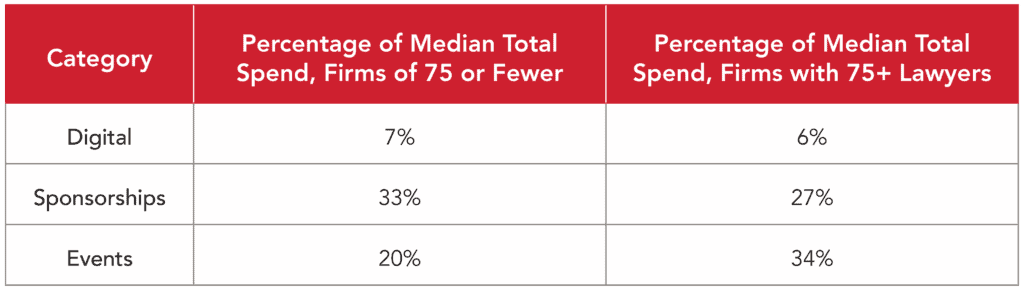
    To understand the significance, it’s helpful to see how firms allocated resources to these categories before the pandemic. While every firm (and every marketing budget) is a little different, ALM Legal Intelligence benchmarks provide some pre-COVID guideposts:

    For both firm sizes, sponsorships and events comprised more than half of their marketing budgets – and soon could be overtaken by the category in single digits.

    Key takeaway: If you are among the many law firms about to invest more in digital marketing, make sure you are doing so purposefully.

    One primary concern: the law firm website. Your social media, paid search, organic search and digital advertising will drive traffic to your website. It is the foundation of it all. Is your current site designed to close business? Does it provide the evidence prospective clients need to know you are a safe choice? Given that more than half of your visitors will look at lawyer bios, are their profiles smart and memorable?

    Second: your digital strategy (or lack thereof). It is easy to waste a considerable amount of time and money online (as many of our Netflix and Amazon accounts will attest). It is hard to rank for keywords that people actually use. It is hard to build a loyal and engaged following on social media. It is hard to capture a prospect’s attention with a digital ad, and to lead them through a sales cycle. Do not believe consultants who say otherwise.

    Instead, approach your digital marketing like you would your old-school business development:

    • Make the right first impression. Your website is now your reception area.
    • Show up to network where your prospects are. Be present on relevant social media. Consider Google your new referral source, and ensure your SEO answers that age-old question “Does anyone know anyone who does this?”
    • Build your credibility. Without live events to serve as your platform, share online articles and speak at webinars.

    COVID-19 brought a massive shakeup to law firm operations. Smart firms will take this opportunity to reevaluate their marketing strategies with creativity, purpose and empathy for the clients. Pitfalls abound for the firms that try to keep pandemic budgets forever or rush into digital without a clear plan.

  • How to Write Case Studies That Close Business

    How to Write Case Studies That Close Business

    Attorney experience: It’s the No. 1 selection factor for prospective clients, beating out firm brand, pricing and more. Indeed, clients want attorneys who can solve problems like theirs; clients want to see you’ve been there before.

    So presenting evidence of this experience – through readable and relevant case studies – is one of the most effective tools in the law firm marketing arsenal. It’s one thing to say you’re the master of the niche;it’s another to show powerful examples.

    The problem: Most lawyer experience is presented as throwaway text.

    Do any of these sound familiar from bios or practice group materials?

    “Represented client in trademark dispute. Settled on terms favorable to client.”

    What kind of client? Was it a cease-and-desist spat or full-on litigation in federal court? What actually happened?

    “Handled numerous shareholder disputes.”

    As plaintiff or defense? Does “handled” mean won or lost? Numerous shareholder disputes for the same client, in the same industry, or 31 flavors of shareholder disputes?

    “Lex Luthor v. Stark Industries, 2017 XX 123456 (D. Kan. 2017).”

    Yes, reported decisions can be legitimizing. But as a standalone bullet point? You’re giving the reader homework. You’re putting it on them to look up the case, read it, and interpret through dense legal writing how your brilliance prevailed.

    All three of these examples of experience are problematic. All three inspire more answers than confidence. All three are dull. But worse, all three are about the lawyer – not the client. In fact, this kind of verb-first construction removes the client altogether…and that’s where the good stuff is.

    You want your prospective clients to be able to see themselves in your experience. You want them to identify with the size of company you have worked with; the situation at play; the industry in question. The more you can make your experience feel relevant to them, the safer your prospects will feel choosing you.

    In short, it’s not about you. It’s about them.

    Let’s rework one of those blurbs from above: “Represented client in trademark dispute. Settled on terms favorable to client.” How can we create a story to show why this matters?

    Here’s a formula for very effective case studies. Consider the four S’s of storytelling:

    • Situation
    • Stakes
    • Solution
    • Success

    Situation

    In one sentence, what’s the problem?

    In our example: “Our client, a manufacturer, was accused by a rival of trademark infringement.”

    Stakes

    What did the client stand to win or lose? Why did this matter to their business or their family?

    Continuing our example: “The competitor wanted to stop all sales of one of our client’s products and sought millions in damages.”

    OK, now you have my attention.

    Solution

    What did you do? How did you fix the problem?

    “Instead of engaging in lengthy litigation, we set up a collaborative discussion with the competitor.”

    Success

    What was the end result? Think beyond the courtroom or board room. What did this matter mean in business or personal terms?

    To conclude our hypothetical: “The competitor agreed to drop all claims if our client changed its product’s name and packaging. In exchange, the competitor paid for a new design and marketing materials. The new product is on shelves now, preserving an important revenue stream.”

    Look at the before and after:

    In a story format, this shows conflict, resolution, business stakes and problem-solving skills. It’s so much more compelling, and it’s so much more memorable. Most importantly, it’s so much more relatable: This blurb will get the attention of manufacturers, companies with troublesome rivals and companies that worry about cash flow.

    One critical caveat: You must be mindful of client confidentiality. Ask permission, even if you do not use the client’s name. You never want a client to be surprised to see their story on your website. Privilege, as always, is paramount.

    Once you have client permission and you have written your case studies in line with the four S approach, deploy them. Include them on attorney biographies. Include them in practice group materials. Post them in a prominent place on your website: Consider a heading in your navigation like Results or Experience. Roll them into your submissions for Chambers USA and regional or trade award programs.

    And when it’s time to pitch for a specific piece of business, choose the case studies that are most likely to resonate with the client. Break them out of the rest of your proposal; put them in a separate “Executive Summary” introduction.

    Then say the four magic words: “Most relevant to you.”

    “This proposal includes background on our firm and practice team, as well as biographies for the individual lawyers. First, we wanted to share some of our recent experience. Most relevant to you…”

    When you put the client first, show an understanding of their situation, and demonstrate true problem-solving, you allow your case studies to, well, make your case, and you will start to see your previous matters generate compound interest.

  • Your Brand in Action: Biographies

    In the business of law, the people are the products. Just as Nike shoes all carry a swoosh, your lawyer biographies should carry the firm’s brand identity with purpose, consistency and confidence.

    These documents may not be as visually striking as a law firm website or reception area, but lawyer biographies pack a powerful branding punch because of their high use: According to Greentarget’s State of Content & Digital Marketing Survey, 71 percent of C-suite executives ranked bios as important tools in lawyer screening and selection, and 64 percent of in-house counsel did the same.

    With a little creativity – and the guts to deviate from the tried-and-true – your bios can bolster the firm’s collective brand, while differentiating individual attorneys with relevance and memorability.

    The Narrative

    A strong brand does not try to be everything to everyone; it makes a firm formidable by focusing on a discrete set of services for a discrete set of clients. So as you write your firm biographies, first answer: Who hires you?

    A biography for an M&A lawyer who serves the Fortune 50 should look, sound and feel different than a bio for a plaintiffs’ attorney who represents individuals who have suffered great tragedy. Are your prospects more comfortable with Lois or Ms. Lane? Do they know and love industry jargon, or should your bio be more conversational? Come to them on their own terms.

    Additionally, each lawyer biography should advance the firm’s brand promise. For example, PEAK Litigation is a litigation boutique founded by Big Law expatriates. The law firm’s key differentiator is its commitment to alternative fee structures; unlike the majority of its competitors, it eschews the billable hour in favor of straightforward budgeting and flat fees.

    Throughout its website, PEAK Litigation needles the rigidity of the Big Law model, promising an approach rooted in teamwork and collaboration. That carries through to the biographies, which are written in engaging first-person with a revolutionary spirit. As one partner writes: “The billable hour is tradition. But it is not a good tradition. It subconsciously incentivizes inefficiency. It also drives a small wedge between the interests of the attorney and the interest of the client. I am dedicated to the demise of the billable hour.”

    Bartimus Frickleton Robertson Rader took a novel approach to accommodate two audiences: the lawyers who refer cases, and the regular people who might need their help. Because the firm serves people who have suffered catastrophic loss, it is imperative to build trust and show empathy.

    To connect with both of these groups, the firm’s website has two narratives for each lawyer. “My Bio” is a traditional professional biography that shows referral sources (and opposing counsel) bona fides and credentials. “My Story” shares details about the lawyer’s personal life and professional journey. These stories offer memorable details, such as entering law school right after service in the Vietnam War. This dual-narrative structure allows Bartimus Frickleton to convey professional credibility without sacrificing approachability and humanity.

    The Photograph

    Think how you can carry the firm’s brand promise through to the visuals on the biographies, too. How should the lawyers be photographed? Are you a smiling firm or a stern firm? Suited or casual?

    EIP is an international intellectual property boutique that introduces itself as “Better, different” on the home page of its website. A firm that puts “different” in 60-point type would fail to follow through if the attorney biographies had the traditional head-and-shoulders, suit-and-tie mug shots. Instead, the firm’s lawyers are shown in compelling black and white photos, tie-less and….seated at a table. The attorneys are shot leaning forward, a pose that puts the viewer on the same level and evokes a feeling of getting down to business. (The technique nabbed EIP a spot on Great Jakes’ list of “The World’s Best Attorney Bio Portraits.”)

    Miller Johnson, meanwhile, uses the traditional lawyer portraits with a nice twist. The Michigan-based law firm’s brand promise is “Down to Earth, Down to Business” – lawyers who are approachable, grounded and human. To that end, the firm’s lawyers have two photos on their biographies: A “Down to Business” picture in business attire, and a “Down to Earth” photo that shows hobbies, families, “real life.” A quick review shows lawyers fishing, watching football and playing with kids and grandkids. It’s a warm detail that reinforces the firm’s promise of relatable human beings.

    The Extras

    Adding an extra flourish or two to lawyer biographies can build on the brand – and make the lawyers more memorable.

    Testimonials. Pillsbury Winthrop Shaw Pittman promises “preeminent lawyers…known for exceptional performance.” To that end, many lawyer biographies include a testimonial or accolade as the lead sentence…in bright blue, 40-point type.

    These blurbs get your attention – and they quickly establish the lawyer as a force. In one personal favorite, the CEO of a bank praises a Pillsbury securities litigator: “I have never before seen such a surgically complete dissection of a complaint as achieved by you and your team.” Because this is actual marketing evidence, it is so much stronger than the usual “John Doe is a securities litigator who has 30 years of experience.”

    Personal Detail. Edelson PC is a plaintiffs’ shop with lofty crusades. Among its introductory statements: Fighting to Protect the Planet, Pioneers in Privacy Class Action, Protecting Communities in the Opioid Epidemic. The firm’s brand is high energy; its offices have golf simulators and a rap-battle mural. It boasts of “epic” holiday parties, and this swagger carries through to the lawyer bios.

    The unconventional bios answer questions ranging from favorite class to perfect vacation, and a graphic for each lawyer shows favorite emoji, daily cups of coffee consumed, typical mode of transportation and, fitting for lawyers protecting the planet, desired superpower. It would be a major disconnect at a white-shoe corporate firm, but the creativity and personal detail cements the firm’s personality for potential clients and recruits.

    One note of caution: Because the goal of a firm brand is to present a unified voice to the marketplace, it is imperative that your lawyer bios be formatted consistently and with purpose. If only one or two lawyers go casual, or if your bios vacillate between first- and third-person, it will be more distracting than solidifying.

    Like all branding efforts, your bios should be authentic and relevant – if a tactic doesn’t feel like it’s “you,” move on. People will respond to genuine and sincere over cool and clever every time. Even if that doesn’t include a favorite emoji – and for many corporate clients, perhaps especially if that doesn’t include a favorite emoji.