Category: Industry Insights

  • Remember Your Reception Area is Marketing, Too

    Remember Your Reception Area is Marketing, Too

    “Client service” is often cited as a differentiator for lawyers and law firms, but seldom do we think about its front line: the reception area. Because it’s a face-to-face action, a visit to your reception area will tell your clients more about your firm than a clever tagline or snazzy logo ever could.

    Are you selling your firm as creative and innovative, but greeting your visitors with stodgy furniture and magazines from the Carter Administration? Worse, are you touting “exceptional client service” in your marketing materials, only to leave clients cold and ignored in a sterile waiting room?

    It’s time to align your reception area with your brand. (Unless your brand is “rude and outdated,” of course.) Some tips to make your best first impression:

    • Create a relaxing environment. Visiting a law firm is often a stressful experience; show some empathy by taking that into account, as well as the inherent obnoxiousness of waiting. In “The Psychology of Waiting,” Psych Central shares that “occupied time feels shorter.” Give visitors reading materials, television or music. (Don’t turn the TV to political fare or unpredictable reality programming. When it comes to music, think instrumental and mellow.)
    • Coordinate a welcome. Let your reception staff know your meeting schedule and empower them to greet your visitors. Hearing “Oh yes, you’re here to meet with Jane Doe, she is expecting you” is so much nicer than the old “And you are?” If you do not have anyone stationed at the desk, make a sign with a greeting and instructions for your visitors; they should not wonder what they are supposed to do.
    • Manage expectations. Psychology Today also reports that uncertainty makes waiting seem longer. If the attorney or paralegal will be late to the appointment, the greeter should apologize and give a reasonable estimate for arrival.
    • Tend to technology. The Lawyerist recommends providing a charging station with universal cables and a guest Wi-Fi network.
    • Consider the kiddos. Sometimes life happens, and your clients will have their children with them. As The Lawyerist points out, “If you don’t plan for children, they will always be disruptive … with a little planning, you can minimize the disruption.” Keep some emergency crayons or blocks on hand. Parents will thank you.
    • Remember who you are. What’s your firm identity, and how can the reception area support that? If you are an authoritative corporate firm, national business magazines make sense. If you’re serving startups, think “Shark Tank.” Just like your brochures or website, your reception area should back up the brand.

    Above all, be human: Think about your own pet peeves when you visit a doctor or accountant, and try to avoid those. For fun, I asked my Facebook friends what irritated them about reception areas. The major offenders:

    • “A bowl of that awful hard candy assortment that features butterscotch and those gross strawberry things, pens with plastic flowers attached, weird magazines.”
    • “Cheap-looking fake plants, especially if they haven’t been dusted. Same goes for live plants. If they are dead, don’t have them out.”
    • “Oldies music played too loud.”
    • “No coffee at 9 a.m.”
    • “Magazines in bad shape, like torn or with the address labels cut off, like they came from someone’s house.”
    • “The pens with the stupid flowers. For *&%$’s sake, we’re not going to steal your *&%$ pens. That tells us you don’t trust your clients.”
    • “Flower pens. And waiting forever. And old or regionally specific magazines. Bad or slow wifi.”

    The flower pens hit a collective nerve, to be sure, but one commenter made the most meaningful point: “Would it be a big deal to acknowledge someone’s presence and greet them? Would you walk past a guest in your house and not speak to them? People in your reception areas are guests.”

    Photo credit: Chair, © 2016 Dean Hochman via Creative Commons.  All rights reserved.
  • How to Make That Last-Minute CLE a Networking Tool

    So you’ve put off your Continuing Legal Education requirements until the last minute, and now you find yourself sitting in a ballroom with your fellow procrastinators. Perhaps it’s not the most interesting presentation, or perhaps it’s totally unrelated to your practice, but you’re going to be there for several hours – how do you turn this into helpful networking?

    I spoke with Kelly Hoey, a recovering lawyer and the author of Build Your Dream Network, an exceptionally helpful guide to building professional connections in the hashtag era. Kelly had several ideas on how to use a last-minute CLE session to further your personal brand and your network.

    How can you turn a potentially irrelevant CLE into smart networking time?

    Here are some quick ideas to use this to your advantage:

    • Add a little personalization or humor to your standard out-of-office message notifying clients/contacts that you’re taking care of your CLE – this can be a conversation-starter.
    • Proactively email the clients/contacts you’d likely hear from while you’re out of the office to let them know you pushed it off as long as you could, but CLE is taking front seat so you can continue to represent them in the coming year!
    • Recognize that you are likely not alone in leaving CLE to the last moment, so introduce yourself to others at the program (misery does love company after all).
    • Keep an open mind; you may learn something from the seemingly irrelevant CLE program and that can be turned into content…then shared with your network via a blog post or newsletter or LinkedIn update.

    How can you network in a classroom setting when everyone is there to sit and learn?

    Remember your networking time extends beyond the physical space that you’re sitting in. Networking is every human interaction! Picking up on the tips above: Update your voice mail message, change your out-of-office responder, let your office receptionist or admin assistant know where you are (give them a script to tell clients/contacts where you are and how to reach you that day), and/or share an update on LinkedIn detailing the CLE you’re attending. You may discover a connection is in the same CLE boat and arrange to meet during the session.

    What’s a good way to introduce yourself and engage with the conference speakers?

    My suggestion is to review the speakers’ bios in advance, and if there is someone you’re interested in continuing a conversation with, hand them your card before the program begins (people rarely talk to speakers before they speak). Offer your card with a brief “I look forward to your remarks and would love to speak with you at a later time, as I suspect you’ll be bombarded after the session.” Alternatively, reach out to them with a personalized note on LinkedIn to connect. Remember to personalize that request to connect on LinkedIn, such as by adding a reference to the CLE session and the insight or takeaway you found valuable.

    What are good networking goals for a CLE program?

    CLE is about information and learning, so start your networking there. Are there insights from the program you can share with your clients or colleagues back at the office? How about content for a LinkedIn article (FYI – general counsel use LinkedIn to enhance their own careers, to keep in touch with outside counsel and to get their business and professional news – so create some content from the CLE program with them in mind).

    You can learn more about Kelly (and subscribe to her newsletter) here. 

  • Presenting Your Personal Brand: Studies Show Less Is More

    When it comes to your personal brand — your biography, LinkedIn profile and more — scientific evidence shows more isn’t necessarily better.

    Indeed, psychologists identified a phenomenon known as the “Presenter’s Paradox,” which states that mentions of your minor qualifications can detract from your major strengths. Writing in Harvard Business Review, author and scientist Heidi Grant said it is a “fascinating example of how our instincts about selling…can be surprisingly bad.”

    Here’s a hypothetical illustration of the Presenter’s Paradox in action:

    Attorney Jane Doe’s biography states that she went to a top law school, achieved a multimillion-dollar jury verdict, and earned “Lawyer of the Year” designation from a regional bar association. These are all impressive qualifications — each ranking 10 on a 10-point scale. Jane’s bio ends with a tacked-on sentence: “During college, Jane had an internship with a software company.” It’s a brief mention of a gig that suggests limited responsibility and relevance, so it’s maybe a 3.

    We often think “more is better,” so 10 + 10 + 10 + 3 would give Jane a 33, right? Wrong. The Presenter’s Paradox shows that instead of cumulating your score of credentials, audiences actually average it out. So, 10 + 10 + 10 + 3, divided by four, is 8.25. By adding in a minor qualification, Jane dragged down her average. She actually became less appealing.

    For more information on the Presenter’s Paradox – and how to make your best case for you – check out my full article in Forbes.

  • Beware the Seven Deadly Sins of Attorney Bios

    Forget flashy advertising, catchy taglines or firm logo Frisbees. The professional biography is the paramount piece in any attorney’s marketing arsenal.

    In law, the people are the product, and no other marketing communications vehicle can convey the depth of an attorney’s experience and qualifications. Over the past 12 years, I have worked with more than 800 attorneys and have seen how clients use bios to assess how credible and hireable law firms are. Indeed, more than 80% of in-house counsel use lawyer bios to research new providers, according to the 2016 Canadian Digital Legal Survey.

    It’s unfortunate, then, that so many bios stagnate with outdated information and neglect the needs of the end user. Attorneys who want to maximize the effectiveness of their bios – and their ability to connect with prospective clients – should work to avoid the seven deadly sins of lawyer bios:

    1. Listing Stale Or Incorrect Information

    This is the least forgivable bio offense; if you have outdated information on your bio, you can sell yourself short, appear out-of-touch or mislead your readers. Fortunately, it’s also the easiest to correct. Check your bio at least once a year for simple accuracy by reviewing the following:

    • Title
    • Court admissions
    • Extracurriculars
    • Publications
    • Presentations
    • Awards
    • Firm leadership positions

    2. Telling, Not Showing

    Consider these two bios:

    • “Lex Luthor is an accomplished litigator who is well-known for his success in jurisdictions across the country.”
    • “Clark Kent has an exceptional track record in litigation nationwide. Accomplishments include a defense verdict for an agribusiness company in Missouri, a $5.6 million verdict for an accident victim in Georgia and the dismissal of a class action for a manufacturer in Utah.”

    In the second one, examples enhance credibility and provide evidence to back your claims. Of course, privilege is critical, but share what your client permits and link to articles and decisions. Demonstrate that you are a safe choice.

    For the rest of the Deadly Sins – and ways to stay on the path of bio righteousness – check out the rest of my piece in Forbes.

  • “Don’t Eat Your Weed”: A Case Study in Content That Blazes

    Today is International Marijuana Day, so we’ve been told – a fine time to revisit a favorite piece of lawyer content marketing: “Don’t Eat Your Weed,” a folk song by the Texas-based firm of Hutson & Harris.

    Content marketing is such a powerful marketing tool; it can build your reputation, cement your credentials and provide prospects with a sample of your style. It’s also hard to do right, especially in the legal arena: There’s a lot of competition, and there’s a lot of dry subject matter. You’re not likely to differentiate yourself with an article that’s a clone of 74 other Supreme Court updates.

    Not all of us are blessed with country music chops or salty subject matter, but “Don’t Eat Your Weed” exemplifies principles of great content marketing that can be applied across the industry. Will Hutson and Chris Harris crafted this fun little earworm of a song around the basic facts that:

    • If you are in possession of less than two ounces of marijuana, it’s a class B misdemeanor.
    • You can make it significantly harder on yourself if you try to alter, conceal or destroy it; then it becomes a felony.

    Why it works:

    • It’s helpful. It provides useful, practical knowledge to the firm’s target base of potential criminal defendants. It’s not about the firm at all. It’s not a song about how great Hutson and Harris are. It’s valuable information.
    • It’s memorable. Fair warning: This song stays with you for days. Viewers may not remember “Hutson & Harris,” but you can easily imagine someone Googling “Don’t Eat Your Weed” months after watching the video.
    • It’s approachable. Hutson and Harris don’t cite a bunch of statutes. They use concise language (“tampering with evidence/ doesn’t make any sense”) and don’t get hung up on jargon.
    • It has personality. Social media is social, after all. People share content that is human, engaging and funny. These guys smile and laugh, and they seem to actually like each other and their jobs. It’s winsome.
    • It seamlessly provides contact information and a call-to-action. Our troubadours have their phone number and website listed at the bottom of the video; they make it easy to find them. And there’s an elegant lyrical promotion woven in: “It’s just a misdemeanor / you can hire a cleaner / to get it off your record.”

    To date, the video has more than 400,000 views. Kudos to this firm for trying something new, putting in the work to make it work, and above all, making “there’s a kind of probation / called deferred adjudication” so catchy.

    (Note: This is not a Firesign client; we don’t know these guys, but we’d like to.)

  • What I Saw at the Revolution: Lessons in Legal Artificial Intelligence

    I’m writing this from 39,000 feet, flying home after the annual Legal Marketing Association convention in Las Vegas. More than 1,200 legal marketers convened to learn, share and connect, and much of this year’s buzz focused on how technology will shape the future of law. Pardon the pun, but I’m still processing all of the possibilities.

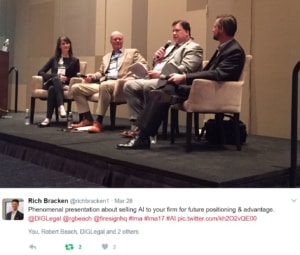
    I was honored to moderate one of two panels on Artificial Intelligence in the legal context. Our panel included Bob Beach of Nexlaw Partners, a technology expert with a master’s degree in computer science; Patrick Fuller of Neota Logic, who has counseled firms on how to deploy data in competitive intelligence and operations; and Steve Fletcher, the chief information officer at Best Best & Krieger, a 200-person firm in California.

    A few takeaways from our discussion:

    • “Artificial Intelligence” doesn’t mean asking Skynet to draft all of your petitions, and it doesn’t have to be scary. It can mean automating routine processes like regulatory forms, so lawyers are freed up to focus on more complex and strategic work. One example is Foley & Lardner’s Global Risk Solutions, which was designed to help middle-market companies comply with the Foreign Corrupt Practices Act.
    • Steve’s firm is working on its first AI project now – an app that will provide guidance on certain California regulations. It’s a great example of collaboration between a firm’s Marketing and IT departments: Steve saw a paper client guide on the topic and asked if it could be automated. He advocates bringing the marketing and IT teams together to daydream – a cool, powerful idea.
    • Patrick shared that AI projects can stimulate cross-selling within a firm. Lawyers can be hesitant to cross-sell another practice area to clients if they are unsure about their peers’ delivery or billing habits. An AI project like Foley’s can help them overcome that hesitation – the product is uniform, easy to demo and predictably priced.
    • AI can also help attract new clients; an app with a straightforward subscription fee might convert some prospects who were price-sensitive or averse to the billable hour.
    • AI also can help law firms capture attorney knowledge. If a lawyer’s specific experience in a regulatory process is put into a decision tree in app form, that app stays with the firm even if the lawyer leaves or retires.
    • We talked about how marketers can get buy-in for an AI project:
      • Work with the IT department to identify the possibility of shared resources, team and budget. Present a unified front of marketing and tech.
      • Make a prototype (even if it’s just an illustration in PowerPoint) so lawyers can see how it will look and function – that makes it more real than just a concept.
      • Show that the AI project isn’t taking away work the firm would otherwise bill for – it should create revenue, not cannibalize it.
      • Gather some attorney champions who will be excited about the possibilities for their practice.
    • Whether it’s a simple form app or Ross, the “digital attorney,” AI brings efficiency and fundamental change. Allen & Overy, for example, created an AI system that takes the time needed to draft a banking document from three hours to three minutes. If you’re an associate who is compensated on billable hours, this is scary stuff – law firms must adjust compensation models to account for the new reality.

    Ultimately, as Bob said, it’s important to remember that clients aren’t asking for AI for AI’s sake; they want you to solve their problems faster, better, cheaper and more proactively. AI may be one way to help, but as with all legal marketing, we can’t be doing it for ourselves. We have to know the clients’ actual problems first, then look for enlightened solutions.

    The Legal Watercooler covered the first AI panel of the convention here.